
UNITED STATES
SECURITIES AND EXCHANGE COMMISSION
WASHINGTON, D.C. 20549
___________________________________________________________
FORM 10-Q
___________________________________________________________
(Mark One)
QUARTERLY REPORT PURSUANT TO SECTION 13 OR 15(D) OF THE SECURITIES EXCHANGE ACT OF 1934 | |||||
For the quarterly period ended September 30, 2026
| TRANSITION REPORT PURSUANT TO SECTION 13 OR 15(D) OF THE SECURITIES EXCHANGE ACT OF 1934 | |||||
For the transition period from to
Commission File No. 001-34972
____________________________________________________________
(Exact name of registrant as specified in its charter)
___________________________________________________________
| (State or other jurisdiction of incorporation or organization) | (I.R.S. Employer Identification No.) | |||||||||||||
| (Address of principal executive offices) | (Zip Code) | |||||||||||||
(703 ) 902-5000
Registrant’s telephone number, including area code
(Former name, former address, and former fiscal year if changed since last report.)
__________________________________________________________
Securities registered pursuant to Section 12(b) of the Act:
| Title of Each Class | Trading Symbol | Name of Each Exchange on Which Registered | ||||||
Indicate by check mark whether the registrant (1) has filed all reports required to be filed by Section 13 or 15(d) of the Securities Exchange Act of 1934 during the preceding 12 months (or for such shorter period that the registrant was required to file such reports), and (2) has been subject to such filing requirements for the past 90 days. Yes ☒ No ☐
Indicate by check mark whether the registrant has submitted electronically every Interactive Data File required to be submitted pursuant to Rule 405 of Regulation S-T (§232.405 of this chapter) during the preceding 12 months (or for such shorter period that the registrant was required to submit such files). Yes ☒ No ☐
Indicate by check mark whether the registrant is a large accelerated filer, an accelerated filer, a non-accelerated filer or a smaller reporting company. See definition of “accelerated filer,” “large accelerated filer” and “smaller reporting company” in Rule 12b-2 of the Exchange Act.
☒ | Accelerated Filer | ☐ | ||||||||||||||||||
| Non-Accelerated Filer | ☐ | Smaller Reporting Company | ||||||||||||||||||
| Emerging Growth Company | ||||||||||||||||||||
If an emerging growth company, indicate by check mark if the registrant has elected not to use the extended transition period for complying with any new or revised financial accounting standards provided pursuant to Section 13(a) of the Exchange Act. ¨
Indicate by check mark whether the registrant is a shell company (as defined in Rule 12b-2 of the Exchange Act). Yes ☐ No ☒
Indicate the number of shares outstanding of each of the issuer’s classes of common stock, as of the latest practicable date.
Shares Outstanding as of 10/19/2026 | |||||
| Class A Common Stock | |||||
TABLE OF CONTENTS
| Page | ||||||||
| ITEM 1 | ||||||||
| ITEM 2 | ||||||||
| ITEM 3 | ||||||||
| ITEM 4 | ||||||||
| ITEM 1 | ||||||||
| ITEM 1A | ||||||||
| ITEM 2 | ||||||||
| ITEM 3 | ||||||||
| ITEM 4 | ||||||||
| ITEM 5 | ||||||||
| ITEM 6 | ||||||||
PART I. FINANCIAL INFORMATION
Item 1. Financial Statements
INDEX TO THE UNAUDITED CONDENSED CONSOLIDATED FINANCIAL STATEMENTS
| Page | |||||
BOOZ ALLEN HAMILTON HOLDING CORPORATION
CONDENSED CONSOLIDATED BALANCE SHEETS
(Unaudited)
(Amounts in millions, except share and per share data)
| September 30, 2026 | March 31, 2026 | ||||||||||
| ASSETS | |||||||||||
| Current assets: | |||||||||||
| Cash and cash equivalents | $ | $ | |||||||||
| Accounts receivable, net | |||||||||||
| Prepaid expenses and other current assets | |||||||||||
| Total current assets | |||||||||||
| Property and equipment, net of accumulated depreciation | |||||||||||
| Operating lease right-of-use assets | |||||||||||
| Intangible assets, net of accumulated amortization | |||||||||||
| Goodwill | |||||||||||
| Deferred tax assets | |||||||||||
| Other long-term assets | |||||||||||
| Total assets | $ | $ | |||||||||
| LIABILITIES AND STOCKHOLDERS’ EQUITY | |||||||||||
| Current liabilities: | |||||||||||
| Current portion of long-term debt | $ | $ | |||||||||
| Accounts payable and other accrued expenses | |||||||||||
| Accrued compensation and benefits | |||||||||||
| Operating lease liabilities | |||||||||||
| Other current liabilities | |||||||||||
| Total current liabilities | |||||||||||
| Long-term debt, net of current portion | |||||||||||
| Operating lease liabilities, net of current portion | |||||||||||
| Postretirement and other long-term employee benefits | |||||||||||
| Other long-term liabilities | |||||||||||
| Total liabilities | |||||||||||
Commitments and contingencies (Note 11) | |||||||||||
| Stockholders’ equity: | |||||||||||
Common stock, Class A - $ issued: | |||||||||||
Treasury stock, at cost - | ( | ( | |||||||||
| Additional paid-in capital | |||||||||||
| Retained earnings | |||||||||||
| Accumulated other comprehensive loss | ( | ( | |||||||||
| Total stockholders’ equity | |||||||||||
| Total liabilities and stockholders’ equity | $ | $ | |||||||||
The accompanying notes are an integral part of these Condensed Consolidated Financial Statements.
1
BOOZ ALLEN HAMILTON HOLDING CORPORATION
CONDENSED CONSOLIDATED STATEMENTS OF OPERATIONS
(Unaudited)
(Amounts in millions, except per share data)
| Three Months Ended September 30, | Six Months Ended September 30, | ||||||||||||||||
| 2026 | 2025 | 2026 | 2025 | ||||||||||||||
| Revenue | $ | $ | $ | $ | |||||||||||||
| Operating costs and expenses: | |||||||||||||||||
| Cost of revenue | |||||||||||||||||
| Billable expenses | |||||||||||||||||
| General and administrative expenses | |||||||||||||||||
| Depreciation and amortization | |||||||||||||||||
| Total operating costs and expenses | |||||||||||||||||
| Operating income | |||||||||||||||||
| Interest expense, net | ( | ( | ( | ( | |||||||||||||
| Other income (expense) | ( | ||||||||||||||||
| Income before income taxes | |||||||||||||||||
| Income tax expense | |||||||||||||||||
| Net income | $ | $ | $ | $ | |||||||||||||
Earnings per share of common stock (Note 4): | |||||||||||||||||
| Basic | $ | $ | $ | $ | |||||||||||||
| Diluted | $ | $ | $ | $ | |||||||||||||
The accompanying notes are an integral part of these Condensed Consolidated Financial Statements.
2
BOOZ ALLEN HAMILTON HOLDING CORPORATION
CONDENSED CONSOLIDATED STATEMENTS OF COMPREHENSIVE INCOME
(Unaudited)
(Amounts in millions)
| Three Months Ended September 30, | Six Months Ended September 30, | ||||||||||||||||
| 2026 | 2025 | 2026 | 2025 | ||||||||||||||
| Net income | $ | $ | $ | $ | |||||||||||||
| Other comprehensive gain (loss), net of tax: | |||||||||||||||||
| Change in unrealized loss/(gain) on derivatives designated as cash flow hedges | ( | ( | |||||||||||||||
| Change in postretirement plan costs | |||||||||||||||||
| Total other comprehensive gain (loss), net of tax | ( | ||||||||||||||||
| Comprehensive income | $ | $ | $ | $ | |||||||||||||
The accompanying notes are an integral part of these Condensed Consolidated Financial Statements.
3
BOOZ ALLEN HAMILTON HOLDING CORPORATION
CONDENSED CONSOLIDATED STATEMENTS OF CASH FLOWS
(Unaudited)
| (Amounts in millions) | Six Months Ended September 30, | ||||||||||
| 2026 | 2025 | ||||||||||
| Cash flows from operating activities | |||||||||||
| Net income | $ | $ | |||||||||
| Adjustments to reconcile net income to net cash provided by operating activities: | |||||||||||
| Depreciation and amortization | |||||||||||
| Noncash lease expense | |||||||||||
| Stock-based compensation expense | |||||||||||
| Net gains on investments, dispositions, and other | ( | ( | |||||||||
| Changes in operating assets and liabilities: | |||||||||||
| Accounts receivable, net | ( | ||||||||||
| Deferred income taxes and income taxes receivable/payable | |||||||||||
| Prepaid expenses and other current and long-term assets | ( | ( | |||||||||
| Accrued compensation and benefits | ( | ||||||||||
| Accounts payable and other accrued expenses | |||||||||||
| Other current and long-term liabilities | ( | ||||||||||
| Net cash provided by operating activities | |||||||||||
| Cash flows from investing activities | |||||||||||
| Purchases of property, equipment, and software | ( | ( | |||||||||
| Payments for business acquisitions and dispositions, net of cash acquired | ( | ||||||||||
Payments for strategic investments | ( | ( | |||||||||
| Net cash used in investing activities | ( | ( | |||||||||
| Cash flows from financing activities | |||||||||||
| Proceeds from issuance of common stock | |||||||||||
| Repurchases of common stock | ( | ( | |||||||||
| Cash dividends paid | ( | ( | |||||||||
| Repayments on term loan | ( | ( | |||||||||
| Net proceeds from debt issuance | |||||||||||
| Net cash provided by (used in) financing activities | ( | ||||||||||
| Net decrease in cash and cash equivalents | ( | ( | |||||||||
| Cash and cash equivalents––beginning of period | |||||||||||
| Cash and cash equivalents––end of period | $ | $ | |||||||||
| Supplemental disclosures of cash flow information | |||||||||||
| Net cash payments during the period for: | |||||||||||
| Interest | $ | $ | |||||||||
| Income taxes | $ | $ | |||||||||
| Supplemental disclosures of non-cash investing and financing activities: | |||||||||||
| Share repurchases transacted but not settled and paid | $ | $ | |||||||||
| Unpaid property, equipment, and software purchases | $ | $ | |||||||||
The accompanying notes are an integral part of these Condensed Consolidated Financial Statements.
4
| BOOZ ALLEN HAMILTON HOLDING CORPORATION CONDENSED CONSOLIDATED STATEMENTS OF STOCKHOLDERS’ EQUITY (Unaudited) | |||||||||||||||||||||||||||||
| (Amounts in millions, except share data) | Class A Common Stock | Treasury Stock | Additional Paid-In Capital | Retained Earnings | Accumulated Other Comprehensive Loss | Total Stockholders’ Equity | |||||||||||||||||||||||
| Shares | Amount | Shares | Amount | ||||||||||||||||||||||||||
| Balance at June 30, 2026 | $ | ( | $ | ( | $ | $ | $ | ( | $ | ||||||||||||||||||||
| Issuance of common stock | — | — | — | — | — | ||||||||||||||||||||||||
| Stock options exercised | — | — | — | — | — | ||||||||||||||||||||||||
Repurchase of common stock (1) | — | — | ( | ( | — | — | — | ( | |||||||||||||||||||||
| Net income | — | — | — | — | — | — | |||||||||||||||||||||||
| Other comprehensive income, net of tax | — | — | — | — | — | — | |||||||||||||||||||||||
Dividends paid of $ | — | — | — | — | — | ( | — | ( | |||||||||||||||||||||
| Stock-based compensation expense | — | — | — | — | — | — | |||||||||||||||||||||||
| Balance at September 30, 2026 | $ | ( | $ | ( | $ | $ | $ | ( | $ | ||||||||||||||||||||
| Balance at March 31, 2026 | $ | ( | $ | ( | $ | $ | $ | ( | $ | ||||||||||||||||||||
| Issuance of common stock | — | — | — | — | — | ||||||||||||||||||||||||
| Stock options exercised | — | — | — | — | — | ||||||||||||||||||||||||
Repurchase of common stock (2) | — | — | ( | ( | — | — | — | ( | |||||||||||||||||||||
| Net income | — | — | — | — | — | — | |||||||||||||||||||||||
| Other comprehensive income, net of tax | — | — | — | — | — | — | |||||||||||||||||||||||
Dividends paid of $ | — | — | — | — | — | ( | — | ( | |||||||||||||||||||||
| Stock-based compensation expense | — | — | — | — | — | — | |||||||||||||||||||||||
| Balance at September 30, 2026 | $ | ( | $ | ( | $ | $ | $ | ( | $ | ||||||||||||||||||||
(1) During the three months ended September 30, 2026, the Company purchased 1.3 million shares of the Company’s Class A Common Stock for $99 million. Additionally, the Company’s repurchase of common stock for the three months ended September 30, 2026 includes $1 million to cover the minimum statutory taxes on repurchases and restricted stock units that vested on various dates during the period.
(2) During the six months ended September 30, 2026, the Company purchased 2.0 million shares of the Company’s Class A Common Stock for $149 million. Additionally, the Company’s repurchase of common stock for the six months ended September 30, 2026 includes $11 million to cover the minimum statutory taxes on repurchases and restricted stock units that vested on various dates during the period.
The accompanying notes are an integral part of these Condensed Consolidated Financial Statements.
5
| BOOZ ALLEN HAMILTON HOLDING CORPORATION CONDENSED CONSOLIDATED STATEMENTS OF STOCKHOLDERS’ EQUITY (Unaudited) | |||||||||||||||||||||||||||||
| (Amounts in millions, except share data) | Class A Common Stock | Treasury Stock | Additional Paid-In Capital | Retained Earnings | Accumulated Other Comprehensive Income (Loss) | Total Stockholders’ Equity | |||||||||||||||||||||||
| Shares | Amount | Shares | Amount | ||||||||||||||||||||||||||
| Balance at June 30, 2025 | $ | ( | $ | ( | $ | $ | $ | ( | $ | ||||||||||||||||||||
| Issuance of common stock | — | — | — | — | — | ||||||||||||||||||||||||
| Stock options exercised | — | — | — | — | — | ||||||||||||||||||||||||
Repurchase of common stock (3) | — | — | ( | ( | — | — | — | ( | |||||||||||||||||||||
| Net income | — | — | — | — | — | — | |||||||||||||||||||||||
Dividends paid of $ | — | — | — | — | — | ( | — | ( | |||||||||||||||||||||
| Stock-based compensation expense | — | — | — | — | — | — | |||||||||||||||||||||||
| Balance at September 30, 2025 | $ | ( | $ | ( | $ | $ | $ | ( | $ | ||||||||||||||||||||
| Balance at March 31, 2025 | $ | ( | $ | ( | $ | $ | $ | ( | $ | ||||||||||||||||||||
| Issuance of common stock | — | — | — | — | — | ||||||||||||||||||||||||
| Stock options exercised | — | — | — | — | — | ||||||||||||||||||||||||
Repurchase of common stock (4) | — | — | ( | ( | — | — | — | ( | |||||||||||||||||||||
| Net income | — | — | — | — | — | — | |||||||||||||||||||||||
| Other comprehensive loss, net of tax | — | — | — | — | — | — | ( | ( | |||||||||||||||||||||
Dividends paid of $ | — | — | — | — | — | ( | — | ( | |||||||||||||||||||||
| Stock-based compensation expense | — | — | — | — | — | — | |||||||||||||||||||||||
| Balance at September 30, 2025 | $ | ( | $ | ( | $ | $ | $ | ( | $ | ||||||||||||||||||||
(3) During the three months ended September 30, 2025, the Company purchased 1.9 million shares of the Company’s Class A Common Stock for $207 million. Additionally, the Company’s repurchase of common stock for the three months ended September 30, 2025 includes $3 million to cover the minimum statutory taxes on repurchases and restricted stock units that vested on various dates during the period.
(4) During the six months ended September 30, 2025, the Company purchased 3.3 million shares of the Company’s Class A Common Stock for $361 million. Additionally, the Company’s repurchase of common stock for the six months ended September 30, 2025 includes $16 million to cover the minimum statutory taxes on repurchases and restricted stock units that vested on various dates during the period.
The accompanying notes are an integral part of these Condensed Consolidated Financial Statements.
6
BOOZ ALLEN HAMILTON HOLDING CORPORATION
NOTES TO UNAUDITED CONDENSED CONSOLIDATED FINANCIAL STATEMENTS
(Amounts in tables in millions, except share and per share data or unless otherwise noted)
1. Business Overview
2. Basis of Presentation
Certain amounts reported in the Company's prior fiscal year condensed consolidated financial statements have been reclassified to conform to the current year presentation, specifically the reclassification of long-term employee benefit related balances for fiscal 2026 from “Other long-term liabilities” into “Postretirement and other long-term employee benefits” on the condensed consolidated balance sheets. There are no changes to the Company’s overall financial position or results of operations as a result of this reclassification.
Accounting Estimates
The preparation of interim consolidated financial statements in conformity with GAAP requires management to make estimates and assumptions that affect the reported amounts of assets, liabilities, revenue and expenses, and related disclosures. Actual results may differ from those estimates. There have been no material changes in the Company’s significant estimates from those disclosed in its Annual Report on Form 10-K for the year ended March 31, 2026.
Recently Issued Accounting Pronouncements Not Yet Adopted
In November 2024, the FASB issued ASU 2024-03, Disaggregation of Income Statement Expenses, which is intended to enhance transparency into the nature and function of certain expenses as specified by the ASU. The guidance does not change the expense captions an entity presents on the face of the income statement; rather, it requires public business entities to provide disaggregated disclosures of certain expense captions in the notes to the financial statements. The ASU is effective for annual periods beginning after December 15, 2026, and interim periods within fiscal years beginning after December 15, 2027, and can be applied retrospectively or prospectively. The Company is currently assessing the impact of this update; however, its adoption will affect only the Company’s disclosures, with no impacts to its results of operations or financial condition.
In September 2025, the FASB issued ASU 2025-06, Targeted Improvements to the Accounting for Internal-Use Software, to modernize the accounting for and disclosure of internal-use software costs. The guidance removes all references to project stages, defines the threshold to begin capitalizing costs, and clarifies the disclosure requirements of capitalized software costs. The ASU is effective for annual periods beginning after December 15, 2027, and interim periods within those fiscal years, and can be applied retrospectively, prospectively, or on a modified transition approach. Early adoption is permitted. The Company is currently assessing the impact of this update.
7
BOOZ ALLEN HAMILTON HOLDING CORPORATION
NOTES TO UNAUDITED CONDENSED CONSOLIDATED FINANCIAL STATEMENTS
(Amounts in tables in millions, except share and per share data or unless otherwise noted)
3. Revenue
| Revenue by Contract Type: | Three Months Ended September 30, | Six Months Ended September 30, | ||||||||||||||||||||||||||||||
| 2026 | 2025 | 2026 | 2025 | |||||||||||||||||||||||||||||
| Cost-reimbursable | $ | % | $ | % | $ | % | $ | % | ||||||||||||||||||||||||
| Time-and-materials | % | % | % | % | ||||||||||||||||||||||||||||
| Fixed-price | % | % | % | % | ||||||||||||||||||||||||||||
| Total Revenue | $ | % | $ | % | $ | % | $ | % | ||||||||||||||||||||||||
Revenue by Customer Type: | Three Months Ended September 30, | Six Months Ended September 30, | ||||||||||||||||||||||||||||||
| 2026 | 2025 | 2026 | 2025 | |||||||||||||||||||||||||||||
| National Security | $ | % | $ | % | $ | % | $ | % | ||||||||||||||||||||||||
| Civil and Commercial | % | % | % | % | ||||||||||||||||||||||||||||
| Total Revenue | $ | % | $ | % | $ | % | $ | % | ||||||||||||||||||||||||
Revenue by Whether the Company Acts as a Prime Contractor or a Subcontractor: | Three Months Ended September 30, | Six Months Ended September 30, | ||||||||||||||||||||||||||||||
| 2026 | 2025 | 2026 | 2025 | |||||||||||||||||||||||||||||
| Prime Contractor | $ | % | $ | % | $ | % | $ | % | ||||||||||||||||||||||||
| Subcontractor | % | % | % | % | ||||||||||||||||||||||||||||
| Total Revenue | $ | % | $ | % | $ | % | $ | % | ||||||||||||||||||||||||
Performance Obligations
Contract Related Balances
Changes in contract assets and contract liabilities are primarily due to the timing difference between the Company’s performance of services and payments from customers; contract assets consist mainly of unbilled receivables (the amount of revenue recognized that exceeds the amount billed to the customer), and contract liabilities consist mainly of deferred revenue (cash received prior to performance for programs and billings in excess of costs incurred). The following table summarizes the contract related balances recognized on the Company’s condensed consolidated balance sheets:
| Description of Contract Related Balance | Balance Sheet Line Item | September 30, 2026 | March 31, 2026 | |||||||||||
| Accounts receivable, net | Accounts receivable, net | $ | $ | |||||||||||
| Accounts receivable–billed | Accounts receivable, net | |||||||||||||
| Allowance for credit losses | Accounts receivable, net | ( | ( | |||||||||||
| Current contract assets - unbilled receivables | Accounts receivable, net | |||||||||||||
| Non-current contract assets - unbilled receivables | Other long-term assets | $ | $ | |||||||||||
| Current contract liabilities - deferred revenue | Other current liabilities | $ | $ | |||||||||||
8
BOOZ ALLEN HAMILTON HOLDING CORPORATION
NOTES TO UNAUDITED CONDENSED CONSOLIDATED FINANCIAL STATEMENTS
(Amounts in tables in millions, except share and per share data or unless otherwise noted)
The majority of the increase in contract assets relates to the acquisition of Defy Security in the first quarter of fiscal 2027. See Note 5, “Acquisitions, Goodwill, and Intangible Assets,” to the condensed consolidated financial statements for further details on the acquisition.
For the three months ended September 30, 2026 and 2025, we recognized revenue of $5 million and $1 million, respectively, and for the six months ended September 30, 2026 and 2025 we recognized revenue of $20 million and $12 million, respectively, related to our contract liabilities on April 1, 2026 and 2025, respectively.
4. Earnings Per Share
The table below provides a reconciliation of the income used to compute basic and diluted EPS for the periods presented:
| Three Months Ended September 30, | Six Months Ended September 30, | ||||||||||||||||
| 2026 | 2025 | 2026 | 2025 | ||||||||||||||
Numerator (1): | |||||||||||||||||
| Earnings for basic computations | $ | $ | $ | $ | |||||||||||||
| Earnings for diluted computations | $ | $ | $ | $ | |||||||||||||
| Denominator: | |||||||||||||||||
| Weighted-average common stock shares outstanding, basic | |||||||||||||||||
| Dilutive stock options and restricted stock | |||||||||||||||||
| Weighted-average common stock shares outstanding, diluted | |||||||||||||||||
| Earnings per common share: | |||||||||||||||||
| Basic | $ | $ | $ | $ | |||||||||||||
| Diluted | $ | $ | $ | $ | |||||||||||||
5. Acquisitions, Goodwill, and Intangible Assets
Acquisition of Ultra I&C Mission Solutions Business
On August 24, 2026, the Company acquired the Ultra I&C Mission Solutions business (“Ultra Mission Solutions”) for approximately $729 million, subject to certain customary adjustments including net working capital. Ultra Mission Solutions is a defense technology business specializing in mission critical software, encryption, and edge compute products. The acquisition was funded with cash on hand and proceeds from the Company’s recently issued bonds. See Note 8, “Debt”, to the condensed consolidated financial statements for further discussion of the Company’s bonds issued during the period.
The acquisition is accounted for under the acquisition method of accounting, resulting in provisional goodwill of $501 million, which is primarily attributable to the expected synergies between the Company and Ultra Mission Solutions and is partially deductible for tax purposes.
The Company provisionally recognized $284 million of intangible assets, consisting of $213 million of contract related assets and $71 million of developed technology, being amortized primarily over the estimated useful life of thirteen years and eight years , respectively. The remaining net liabilities assumed are provisionally recognized at $56 million, and consist primarily of deferred tax liabilities of $72 million related to the acquired intangibles.
The valuation of the assets acquired and liabilities assumed with the acquisition of Ultra Mission Solutions is provisional and based on valuation estimates and assumptions. Although the Company does not currently expect material changes to the initial value of net assets acquired, the Company continues to evaluate assumptions related to the valuation of the assets acquired and liabilities assumed. Any adjustments to our estimates of purchase price allocation will be made in the periods in which the adjustments are determined, and the cumulative effect of such adjustments will be calculated as if the adjustments had been completed as of the acquisition date.
Acquisition of Defy Security
On April 6, 2026, the Company acquired Defy Security for $235 million. Defy Security will enable the Company to deliver end-to-end, tech-enabled cybersecurity solutions and products for U.S. and foreign customers. The acquisition was funded with cash on hand.
9
BOOZ ALLEN HAMILTON HOLDING CORPORATION
NOTES TO UNAUDITED CONDENSED CONSOLIDATED FINANCIAL STATEMENTS
(Amounts in tables in millions, except share and per share data or unless otherwise noted)
The acquisition is accounted for under the acquisition method of accounting, resulting in provisional goodwill of $128
The Company recognized $88 million of intangible assets which consist of contract related assets and are being amortized over the estimated useful life of eight years . The remaining net assets acquired are recognized at $19 million, which includes current billed and unbilled accounts receivable of $221 million and non‑current unbilled receivables of $89 million, partially offset by current accounts payable and accrued expenses of $217 million and non‑current accrued expenses of $80 million.
The valuation of Defy Security’s assets acquired and liabilities assumed is substantially complete, with the exception of tax assets acquired and liabilities assumed and other certain matters. Any adjustments to our estimates of purchase price allocation will be made in the periods in which the adjustments are determined, and the cumulative effect of such adjustments will be calculated as if the adjustments had been completed as of the acquisition date.
Goodwill
As of September 30, 2026 and March 31, 2026, goodwill was $3,028 million and $2,399 million, respectively. The $629 million increase in the carrying amount of goodwill was attributable to the Company's acquisitions of Defy Security and Ultra Mission Solutions.
Intangible Assets
Intangible assets consisted of the following at the periods presented below:
| September 30, 2026 | March 31, 2026 | |||||||||||||||||||||||||
| Gross Carrying Value | Accumulated Amortization | Net Carrying Value | Gross Carrying Value | Accumulated Amortization | Net Carrying Value | |||||||||||||||||||||
| Amortizable intangible assets: | ||||||||||||||||||||||||||
| Customer contracts and related customer relationships | $ | $ | $ | $ | $ | $ | ||||||||||||||||||||
| Software | ||||||||||||||||||||||||||
| Total amortizable intangible assets | $ | $ | $ | $ | $ | $ | ||||||||||||||||||||
| Unamortizable intangible assets: | ||||||||||||||||||||||||||
| Trade name | $ | $ | — | $ | $ | $ | — | $ | ||||||||||||||||||
| Total | $ | $ | $ | $ | $ | $ | ||||||||||||||||||||
6. Accounts Payable and Other Accrued Expenses
Accounts payable and other accrued expenses consisted of the following at the periods presented below:
| September 30, 2026 | March 31, 2026 | ||||||||||
| Vendor payables | $ | $ | |||||||||
| Provision for claimed costs | |||||||||||
| Accrued interest | |||||||||||
Accrued expenses (1) | |||||||||||
| Total accounts payable and other accrued expenses | $ | $ | |||||||||
(1) Accrued expenses for the period ending September 30, 2026 include $180 million due to the acquisition of Defy Security.
See Note 11, “Commitments and Contingencies,” to the condensed consolidated financial statements for further discussion of the Company’s provision for claimed costs.
10
BOOZ ALLEN HAMILTON HOLDING CORPORATION
NOTES TO UNAUDITED CONDENSED CONSOLIDATED FINANCIAL STATEMENTS
(Amounts in tables in millions, except share and per share data or unless otherwise noted)
7. Accrued Compensation and Benefits
Accrued compensation and benefits consisted of the following at the periods presented below:
| September 30, 2026 | March 31, 2026 | ||||||||||
| Accrued payroll | $ | $ | |||||||||
| Accrued retirement | |||||||||||
| Accrued paid time off | |||||||||||
| Other | |||||||||||
| Total accrued compensation and benefits | $ | $ | |||||||||
8. Debt
Debt consisted of the following at the periods presented below:
| September 30, 2026 | March 31, 2026 | |||||||||||||||||||
| Maturity | Interest Rate | Outstanding Balance | Interest Rate | Outstanding Balance | ||||||||||||||||
| Term Loan A-1 | 9/7/2027 | % | $ | % | $ | |||||||||||||||
| Term Loan A-2 | 2/27/2031 | % | $ | % | $ | |||||||||||||||
| Senior Notes due 2028 | 9/1/2028 | % | % | |||||||||||||||||
| Senior Notes due 2029 | 7/1/2029 | % | % | |||||||||||||||||
| Senior Notes due 2030 | 1/30/2030 | % | % | |||||||||||||||||
| Senior Notes due 2033 | 8/4/2033 | % | % | |||||||||||||||||
| Senior Notes due 2034 | 1/30/2034 | % | % | |||||||||||||||||
| Senior Notes due 2035 | 4/15/2035 | % | % | |||||||||||||||||
| Less: Unamortized debt issuance costs and discount on debt | ( | ( | ||||||||||||||||||
| Total | ||||||||||||||||||||
| Less: Current portion of long-term debt | ( | ( | ||||||||||||||||||
| Long-term debt, net of current portion | $ | $ | ||||||||||||||||||
Booz Allen Hamilton Inc., a wholly owned subsidiary of Booz Allen Hamilton Holding Corporation, as borrower, and Booz Allen Hamilton Holding Corporation, as guarantor, are parties to a Credit Agreement dated as of July 31, 2012, as amended, which as of September 30, 2026, provides the Company with a term loan of $741 million and a $1,500 million revolving credit facility (the “Revolving Credit Facility”), with a sub-limit for letters of credit of $200 million. The Company occasionally borrows under the Revolving Credit Facility for our working capital needs. As of both September 30, 2026 and March 31, 2026, there was no
Booz Allen Hamilton Inc. has issued senior notes in six separate and distinct tranches, as shown in the table above, all of which bear interest at specified rates and have individual and separate maturity dates. The two latest tranches were issued in the second quarter of fiscal 2027, where Booz Allen Hamilton Inc. issued $1.2 billion aggregate principal amount of its senior notes and subsequently paid off the outstanding balance of Term Loan A-1. All senior notes are fully and unconditionally guaranteed on an unsecured and unsubordinated basis by Booz Allen Hamilton Holding Corporation, pursuant to applicable indentures. All senior notes’ indentures contain certain covenants, events of default and other customary provisions.
As of September 30, 2026 and March 31, 2026, Booz Allen Hamilton was in compliance with all financial covenants associated with its debt. For further information on the Company’s debt, including material terms, conditions, restrictions and redemption options, see Note 10, “Debt,” of the Company’s consolidated financial statements included in the fiscal 2026 Annual Report on Form 10-K.
11
BOOZ ALLEN HAMILTON HOLDING CORPORATION
NOTES TO UNAUDITED CONDENSED CONSOLIDATED FINANCIAL STATEMENTS
(Amounts in tables in millions, except share and per share data or unless otherwise noted)
9. Income Taxes
The Company’s effective income tax rates were 9.0 % and 24.9 % for the three months ended September 30, 2026 and 2025, respectively, and 15.8 % and 0.7 % for the six months ended September 30, 2026 and 2025, respectively. Our effective tax rates for these periods differ from the federal statutory rate of 21.0% primarily due to the inclusion of state income taxes and permanent rate differences, which are predominantly related to certain executive compensation and the accrual of reserves for uncertain tax positions, offset by research and development tax credits, excess tax benefits for employee share-based compensation, and the Foreign-Derived Deduction-Eligible Income deduction. In addition, the fiscal year 2026 effective tax rate was also lower related to adjustments to the Company’s uncertain tax position reserves as outlined below.
As of September 30, 2026 and March 31, 2026, the Company recorded $85 million and $75 million, respectively, of reserves for uncertain tax positions (“UTPs”) primarily related to research and development tax credits. During the six months ended September 30, 2025, the Company reduced its UTPs by $86 million related to an adjustment from the completion of Internal Revenue Service (the “IRS”) examination procedures of the Company’s amended federal income tax returns through fiscal year 2021. No similar adjustment was recorded in the six months ended September 30, 2026. Due to the magnitude of the refund requested in the amended returns, the case will be referred to the Joint Committee on Taxation (the “JCT”) for further evaluation, as required by law for tax refunds or reductions exceeding $5 million. While the JCT has not yet reviewed this case, management does not anticipate that the resolution of this review will have a material adverse effect on the Company’s financial position or results of operations. In addition, the Company has accrued a tax benefit for interest income (net of tax effect) on the long-term receivable related to the refund requested on the amended returns of $3 million and $22 million for the six months ended September 30, 2026 and 2025, respectively.
As of September 30, 2026 and March 31, 2026, the Company recorded long-term income tax receivables of $182 million and $178 million, respectively, which represents the amended U.S. federal return refund claims related to the audits referenced above and remains classified as other long-term assets on the condensed consolidated balance sheet as the case is subject to JCT review.
10. Investments and Fair Value Measurements
Investments
Our investments related to unconsolidated entities included in other long-term assets of the Company’s consolidated balance sheets at September 30, 2026 and March 31, 2026 were:
| Investments | September 30, 2026 | March 31, 2026 | |||||||||
| Equity method investments | $ | $ | |||||||||
| Other investments | |||||||||||
| Total Investments | $ | $ | |||||||||
Equity Method Investments
The Company’s equity method investments include investments in two venture capital funds that are considered related parties. The carrying value of these funds included in the table above as of September 30, 2026 and March 31, 2026 was $313 million and $178 million, respectively. The Company’s unfunded capital commitments as a limited partner in these funds at September 30, 2026 was $187 million.
Other Investments - Nonrecurring Fair Value Measurements
As of September 30, 2026 and March 31, 2026, the total of our investments that are accounted for at fair value on a non-recurring basis under the measurement alternative were $184 million and $146 million, respectively. While these assets are not measured at fair value on an ongoing basis, they are subject to fair value adjustments in certain circumstances (e.g., observable price changes or impairment). Cumulative fair value adjustments on these investments through September 30, 2026 were $50 million.
12
BOOZ ALLEN HAMILTON HOLDING CORPORATION
NOTES TO UNAUDITED CONDENSED CONSOLIDATED FINANCIAL STATEMENTS
(Amounts in tables in millions, except share and per share data or unless otherwise noted)
Recurring Fair Value Measurements
The financial instruments measured at fair value on a recurring basis in the accompanying condensed consolidated balance sheets consisted of the following at the periods presented below:
| September 30, 2026 | March 31, 2026 | ||||||||||||||||||||||
| Level 1 | Level 2 | Total | Level 1 | Level 2 | Total | ||||||||||||||||||
| Assets: | |||||||||||||||||||||||
| Money market funds | $ | $ | $ | $ | $ | $ | |||||||||||||||||
| Long-term deferred compensation plan asset | |||||||||||||||||||||||
| Total Assets | $ | $ | $ | $ | $ | $ | |||||||||||||||||
| Liabilities: | |||||||||||||||||||||||
| Current derivative instruments | $ | $ | $ | $ | $ | $ | |||||||||||||||||
| Long-term deferred compensation plan liability | |||||||||||||||||||||||
| Total Liabilities | $ | $ | $ | $ | $ | $ | |||||||||||||||||
The Company did not have any Level 3 assets or liabilities as of September 30, 2026 or March 31, 2026.
Derivatives
The Company utilizes interest rate derivative financial instruments, which were designated as cash flow hedges, to manage its exposure to interest rate risk related to its variable rate debt, and reducing volatility of interest expense as the variable-to-fixed interest rate swaps effectively convert a portion of the variable rate debt into fixed interest rate debt. As of September 30, 2026, the Company’s outstanding interest rate swaps have a total notional amount of $200 million and mature on June 30, 2027.
The Company’s interest rate swaps are considered over-the-counter derivatives which are recorded in the condensed consolidated balance sheet on a gross basis at estimated fair value. Fair value is estimated based on the present value of future cash flows using a model-derived valuation that uses Level 2 observable inputs such as interest rate yield curves. The changes in the fair value of interest rate swaps designated as cash flow hedges are recorded in AOCI, net of taxes, and are subsequently reclassified into interest expense, net in the period that the hedged forecasted interest payments are made on the Company's variable-rate debt. Cash flows associated with periodic settlements of interest rate swaps are classified as operating activities in the condensed consolidated statement of cash flows.
Deferred Compensation Plans
Investments in this category consist primarily of mutual funds whose fair values are determined by reference to the quoted market price per unit in active markets multiplied by the number of units held without consideration of transaction costs. These assets are recorded in other long-term assets and represent investments held in a consolidated trust to fund the Company's non-qualified deferred compensation plan, which is recorded in other long-term liabilities on our condensed consolidated balance sheets.
Cash and Cash Equivalents
As of September 30, 2026 and March 31, 2026, the Company's cash and cash equivalents presented on the accompanying condensed consolidated balance sheets include the money market funds disclosed in the table above. As of September 30, 2026 and March 31, 2026, the fair value of the Company’s cash and cash equivalents approximated its carrying value.
Long-term Debt
The Company's long-term debt is carried at amortized cost and fair value is disclosed on a quarterly basis. The estimated fair value of debt is determined using quoted prices or other market information obtained from recent trading activity of the debt in markets that are not active (Level 2 inputs). The fair value is corroborated by prices derived from the interest rate spreads of recently completed leveraged loan transactions of a similar credit profile, industry, and terms to that of the Company. The fair value of the Senior Notes is determined using quoted prices or other market information obtained from recent trading activity in the high-yield bond market (Level 2 inputs). The carrying amount and estimated fair value of long-term debt for the periods presented are as follows:
13
BOOZ ALLEN HAMILTON HOLDING CORPORATION
NOTES TO UNAUDITED CONDENSED CONSOLIDATED FINANCIAL STATEMENTS
(Amounts in tables in millions, except share and per share data or unless otherwise noted)
| September 30, 2026 | March 31, 2026 | ||||||||||||||||||||||
| Carrying Amount | Estimated Fair Value | Carrying Amount | Estimated Fair Value | ||||||||||||||||||||
| Term Loans | $ | $ | $ | $ | |||||||||||||||||||
| Senior Notes | |||||||||||||||||||||||
| Total Debt | $ | $ | $ | $ | |||||||||||||||||||
11. Commitments and Contingencies
Government Contracting Matters - Provision for Claimed Costs
U.S. government contracts and subcontracts are subject to extensive legal and regulatory requirements. From time to time and in the ordinary course of business, agencies of the U.S. government, including the Defense Contract Audit Agency (“DCAA”), audit the Company’s claimed costs and conduct inquiries and investigations of our business practices with respect to government contracts to determine whether the Company's operations are conducted in accordance with these requirements and the terms of the relevant contracts.
Management believes it has recorded the appropriate provision for claimed costs for any audit, inquiry, or investigation of which it is aware that may be subject to any reductions and/or penalties. As of September 30, 2026 and March 31, 2026, the Company had recorded liabilities (included in accounts payable and other accrued expenses) of approximately $249 million and $248 million for estimated adjustments to claimed costs based on its historical DCAA audit results, including the final resolution of such audits with the Defense Contract Management Agency (“DCMA”), for claimed costs incurred subsequent to fiscal 2011.
Leases
On November 12, 2025, the Company entered into two separate 15 -year lease agreements for two corporate office spaces in Reston, Virginia. The Company plans to relocate its headquarters to these office spaces in the fall of 2027, dependent upon the timing of the completion of various tenant improvements. Under these lease agreements, which were entered into by Booz Allen Hamilton and are guaranteed by the Company, the estimated total undiscounted base lease payments are $240 million and the agreements provide for up to $61 million in tenant improvement allowances as of September 30, 2026. For the quarter ended September 30, 2026, the total lease liabilities arising from obtaining right-of-use assets were $122 million.
Litigation
Our performance under U.S. government contracts and compliance with the terms of those contracts and applicable laws and regulations are subject to continuous audit, review, and investigation by the U.S. government, which may include such investigative techniques as subpoenas or civil investigative demands. Given the nature of our business, these audits, reviews, and investigations may focus, among other areas, on various aspects of procurement integrity, labor time reporting, sensitive and/or classified information access and control, executive compensation, and post-government employment restrictions. We are not always aware of our status in such matters, but we are currently aware of certain pending audits and investigations involving labor time reporting, procurement integrity, and classified information access. In addition, from time to time, we are also involved in legal proceedings and investigations arising in the ordinary course of business, including those relating to employment matters, relationships with customers and contractors, intellectual property disputes, and other business matters. These legal proceedings seek various remedies, including claims for monetary damages in varying amounts, none of which are considered material, or are unspecified as to amount. Although the outcome of any such matter is inherently uncertain and may be materially adverse, based on current information, we do not expect any of the currently ongoing audits, reviews, investigations, or litigation to have a material adverse effect on our financial condition and results of operations.
14
Item 2. Management’s Discussion and Analysis of Financial Condition and Results of Operations
The following discussion and analysis is intended to help the reader understand our business, financial condition, results of operations, and liquidity and capital resources. You should read this discussion in conjunction with our condensed consolidated financial statements and the related notes contained elsewhere in this Quarterly Report on Form 10-Q, or Quarterly Report.
The statements in this discussion regarding industry outlook, our expectations regarding our future performance, liquidity and capital resources, and other non-historical statements in this discussion are forward-looking statements. These forward-looking statements are subject to numerous risks and uncertainties, including, but not limited to, the risks and uncertainties described in our Annual Report on Form 10-K for the fiscal year ended March 31, 2026 filed with the Securities and Exchange Commission on May 22, 2026, or Annual Report, and under Part II, “Item 1A. Risk Factors,” and “— Special Note Regarding Forward-Looking Statements” of this Quarterly Report. Our actual results may differ materially from those contained in or implied by any forward-looking statements.
Our fiscal year ends March 31 and, unless otherwise noted, references to years or fiscal are for fiscal years ended March 31. See “—Results of Operations.”
Overview
Booz Allen is an advanced technology company, building products and solutions for government and business. We are a leader at the forefront of the nation’s technology ecosystem. Our approximately 31,000 employees build tech for a diverse base of federal government and commercial customers, both domestically and in select foreign locations. By investing in emerging technologies, talent, and new business models, including partnerships with leading technology companies, venture investments, and the development of military grade products, we are accelerating the delivery of tech solutions.
Factors and Trends Affecting Our Results of Operations
Our results of operations have been, and we expect them to continue to be, affected by the following factors, which may cause our future results of operations to differ from our historical results of operations discussed under “—Results of Operations.”
U.S. Budgetary and Regulatory Environment
The U.S. continues to face an uncertain and evolving budgetary and regulatory environment, and we expect this uncertainty will continue. Our business performance is affected by the overall level of U.S. government spending and the alignment of our offerings and capabilities with the spending priorities of the U.S. government.
The U.S. government continues to review spending across U.S. government agencies to ensure it aligns with the administration’s priorities of maximizing governmental efficiency and productivity. Additionally, U.S. government agencies continue their own independent reviews of their contract portfolios and future procurements in response to recent executive orders focused on efficiency in government procurement. We have been, and will continue to be, subject to these reviews, and we have had, and may in the future have, certain of our contracts impacted, reduced or canceled or experience price adjustments and renegotiations, as a result of these reviews. There can be no assurance that these reviews will not ultimately have a material adverse impact on our business and financial performance.
The U.S. government has put in place a number of executive orders and actions that could impact our business, including orders intended to (i) simplify and accelerate the procurement process through a review and restructuring of the Federal Acquisition Regulation (“FAR”), and its supplements, (ii) modernize defense acquisitions by promoting commercial solutions, innovative acquisition authorities, and other existing streamlined processes, (iii) limit stock buybacks and the payment of dividends by certain defense contractors and (iv) increase the use of firm-fixed price contracts by federal agencies.
15
The formal rulemaking process regarding the FAR remains ongoing, with many of the formal rules issued and review of public comments underway; however, proposed rules include changes that formalize the FAR's deviation-based approach and make certain streamlining shifts, as well as incorporating a number of other pending rules. In early November 2025, the Secretary of War announced and released an associated memorandum regarding a new acquisition strategy and directing certain reforms addressing Department of War purchases of military weapons, including elevating and empowering the acquisition workforce, maximizing acquisition flexibility, and improving lifecycle risk management. Additionally, on December 18, 2025, the National Defense Authorization Act (“NDAA”) was signed into law, which included a number of reforms that may also impact our business, including exempting nontraditional contractors from certain burdensome compliance requirements. Further, in August 2026, contemporaneously with the issuance of a portion of the formal FAR rulemaking, the Small Business Administration (“SBA”) proposed revisions to its size standards which are intended to streamline the program but have the potential, if implemented, to reshape the small business landscape by significantly expanding eligibility for SBA programs. The impact of the aforementioned changes remains uncertain. The continued focus on removing barriers to new entrants and any related future legislation could reduce the likelihood of direct awards to companies like Booz Allen and affect our competitive position, while the new acquisition strategy and streamlined procurement processes have the potential to have positive impacts on our business.
On January 7, 2026, the President signed an executive order, “Prioritizing the Warfighter in Defense Contracting”, which would restrict stock buy-backs or corporate distributions for underperforming defense contractors, as identified by the Secretary of War. If the Company is identified pursuant to this executive order, it may have a negative impact on our dividends, stock buyback programs, and our ability to attract and retain talented executives. Compliance with the requirements of this executive order may be complex, costly and time-consuming, and our subcontractors may not have the necessary resources to ensure compliance. In addition, in March 2026, certain Senators introduced the Warfighter in Defense Contracting Act of 2026, which would codify and go beyond this executive order by instituting, absent a waiver, a blanket prohibition on such dividends, buybacks, and executive compensation above certain levels. In addition, the Senate Armed Services Committee’s version of the NDAA for Fiscal Year 2027 includes a related provision that would require contractors to submit a qualified defense investment plan to increase production capacity or otherwise face restrictions on stockholder distributions. These proposed legislations far exceed the framework contemplated by the executive order and would introduce significant administrative burdens for us and other companies that could be subject to such legislation.
On April 30, 2026, the President signed an executive order, “Promoting Efficiency, Accountability, and Performance in Federal Contracting,” which directs federal agencies, subject to certain exceptions, (i) to increase the use of firm-fixed price contracts for new awards to the maximum extent consistent with law, and (ii) to seek to modify, restructure, or renegotiate, their top ten highest-dollar-value contracts issued on an other-than-fixed price basis. The Company is supportive of the recent focus by the administration on the increased usage of fixed-price and outcomes-based contracting (we refer to firm fixed price contracts where we deliver a specific outcome for a predetermined price as “outcomes-based contracting”). Compared to time-and-materials and cost-reimbursable contracts, outcomes-based contracting generally offers higher margin opportunities because we receive the benefits of any cost savings, but can involve greater financial risk because we bear the impact of any cost overruns. Additionally, we believe outcomes-based contracting results in more efficient contracting outcomes and potential savings for the U.S. government.
On September 2, 2026, the President signed into law a continuing resolution funding the U.S. government through December 11, 2026. A full-year, comprehensive appropriations agreement has not been reached; therefore future federal funding levels remain subject to uncertainty, and delays or disruptions in the appropriations process, including a prolonged government shutdown, could adversely affect our business, financial condition and results of operations.
Contract Backlog
We define backlog to include the following three components:
•Funded Backlog. Funded backlog represents the value of orders under existing contracts for which funding is appropriated or otherwise authorized less revenue previously recognized on these contracts.
•Unfunded Backlog. Unfunded backlog represents the estimated value of orders under existing contracts for which funding has not been appropriated or otherwise authorized.
•Priced Options. Priced contract options represent the estimated value of all future contract option periods under existing contracts that may be exercised at our customers’ option and for which funding has not been appropriated or otherwise authorized.
Our backlog does not include contracts that have been awarded but are currently under protest and also does not include any task orders under indefinite delivery/indefinite quantity (“IDIQ”) contracts, General Services Administration (“GSA”) Multiple Award schedule contracts (“GSA schedules”) or other master agreement contract vehicles, except to the extent that task orders have been awarded to us under those contracts.
16
The following table summarizes the value of our contract backlog as of the respective periods presented:
| September 30, 2026 | September 30, 2025 | ||||||||||
| (In millions) | |||||||||||
Backlog (1): | |||||||||||
| Funded | $ | 5,711 | $ | 5,440 | |||||||
| Unfunded | 10,409 | 10,668 | |||||||||
| Priced options | 24,813 | 24,080 | |||||||||
| Total backlog | $ | 40,933 | $ | 40,188 | |||||||
(1) Backlog presented includes backlog acquired from the Company’s acquisition of Ultra Mission Solutions during the six months ended September 30, 2026. Total backlog acquired from Ultra was approximately $164 million at the acquisition date.
Our total backlog consists of contractual values which is inclusive of remaining performance obligations, and potential contract value from unexercised option periods and other unexercised optional orders. As of September 30, 2026 and March 31, 2026, the Company had $11.8 billion and $10.7 billion of remaining performance obligations, respectively, and we expect to recognize approximately 65% of the remaining performance obligations as of September 30, 2026 as revenue over the next 12 months, and approximately 75% over the next 24 months. The remainder is expected to be recognized thereafter. We also expect to recognize revenue from a substantial portion of funded backlog as of September 30, 2026, within the next twelve months. However, given the uncertainties discussed below, as well as the risks described in “Item 1A. Risk Factors” of our Annual Report on Form 10-K for the fiscal year ended March 31, 2026, we can give no assurance that we will be able to convert our performance obligations or funded backlog into revenue in any particular period, if at all. Our backlog includes orders under contracts that in some cases extend for several years. The U.S. Congress generally appropriates funds for our customers on a yearly basis, even though their contracts with us may call for performance that is expected to take a number of years to complete. As a result, contracts typically are only partially funded at any point during their term and all or some of the work to be performed under the contracts may remain unfunded unless and until the U.S. Congress makes subsequent appropriations and the procuring agency allocates funding to the contract.
We view growth in total backlog as a key measure of our potential business growth. Total backlog increased by 2% from September 30, 2025 to September 30, 2026. Additions to funded backlog during the twelve months ended September 30, 2026 and 2025 totaled $11.3 billion and $11.4 billion, respectively, as a result of the conversion of unfunded backlog to funded backlog, the award of new contracts and task orders under which funding was appropriated, and the exercise and subsequent funding of priced options.
We cannot predict with any certainty the portion of our backlog that we expect to recognize as revenue in any future period and we cannot guarantee that we will recognize any revenue from our backlog. The primary risks that could affect our ability to recognize such revenue on a timely basis or at all include: program schedule changes, contract modifications and our ability to assimilate and deploy new customer staff against funded backlog; cost-cutting initiatives and other efforts to reduce U.S. government spending, which could reduce or delay funding for orders for services; and, delayed funding of our contracts due to delays in the completion of the U.S. government’s budgeting process and the use of continuing resolutions by the U.S. government to fund its operations, and the other risks and factors listed under “— U.S. Budgetary and Regulatory Environment” in this Quarterly Report, as well as those listed under “Risk Factors” in our Annual Report on Form 10-K for the year ended March 31, 2026. In addition, the amount of our funded backlog is also subject to change due to these factors. In our recent experience, the slowed procurement environment and reductions in contract value have had a negative effect on our ability to convert backlog to revenue as of September 30, 2026, and could have additional impacts in the future to our business and financial performance.
Critical Accounting Estimates and Policies
Our critical accounting estimates and policies are disclosed in the Critical Accounting Estimates and Policies section in Part II, “Item 7. Management's Discussion and Analysis of Financial Condition and Results of Operations” of our Annual Report on Form 10-K for the year ended March 31, 2026.
17
Results of Operations
The following table presents items from our condensed consolidated statements of operations for the respective periods shown:
| Three Months Ended September 30, | Six Months Ended September 30, | ||||||||||||||||||||||
| 2026 | 2025 | 2026 | 2025 | ||||||||||||||||||||
| (Unaudited) | (Unaudited) | Percent | (Unaudited) | (Unaudited) | Percent | ||||||||||||||||||
| (In millions) | Change | (In millions) | Change | ||||||||||||||||||||
| Revenue | $ | 2,778 | $ | 2,890 | (4) | % | $ | 5,578 | $ | 5,814 | (4) | % | |||||||||||
| Operating costs and expenses: | |||||||||||||||||||||||
| Cost of revenue | 1,333 | 1,340 | (1) | % | 2,669 | 2,763 | (3) | % | |||||||||||||||
| Billable expenses | 821 | 918 | (11) | % | 1,656 | 1,799 | (8) | % | |||||||||||||||
| General and administrative expenses | 328 | 308 | 6 | % | 633 | 631 | — | % | |||||||||||||||
| Depreciation and amortization | 51 | 41 | 24 | % | 96 | 81 | 19 | % | |||||||||||||||
| Total operating costs and expenses | 2,533 | 2,607 | (3) | % | 5,054 | 5,274 | (4) | % | |||||||||||||||
| Operating income | 245 | 283 | (13) | % | 524 | 540 | (3) | % | |||||||||||||||
| Interest expense, net | (52) | (48) | 8 | % | (100) | (92) | 9 | % | |||||||||||||||
| Other income (expense) | 6 | (2) | (400) | % | 26 | 1 | 2,500 | % | |||||||||||||||
| Income before income taxes | 199 | 233 | (15) | % | 450 | 449 | — | % | |||||||||||||||
| Income tax expense | 18 | 58 | (69) | % | 71 | 3 | 2,267 | % | |||||||||||||||
| Net income | $ | 181 | $ | 175 | 3 | % | $ | 379 | $ | 446 | (15) | % | |||||||||||
Revenue
Revenue decreased 4% to $2,778 million, and 4% to $5,578, respectively, for the three and six months ended September 30, 2026 compared to the prior year period. The decrease was primarily driven by the impact of a slowed procurement environment in the prior year, which resulted in a slower start to programs in the current year, predominantly from civil customers, leading to reduced headcount and billable expenses.
Cost of Revenue
Costs associated with compensation and related expenses for our people are the most significant component of our operating costs and expenses. The principal factors that affect our costs are the increases or decreases in labor and employee related costs as we are awarded contracts, task orders, and additional work under our existing contracts, and the hiring of people with specific skill sets and security clearances.
Cost of revenue as a percentage of revenue was 48% and 46% for the three months ended September 30, 2026 and 2025, respectively, and 48% for both the six months ended September 30, 2026 and 2025, respectively. Cost of revenue decreased 1% and 3% for the three and six months ended September 30, 2026 as compared to the three and six months ended September 30, 2025. The decreases were primarily due to decreases in salaries and related benefits due to overall headcount reductions. The prior year to date period also includes $30 million in costs related to employee severance and related charges, not present in the current year.
Billable Expenses
Billable expenses as a percentage of revenue were 30% and 32% for the three months ended September 30, 2026 and 2025, respectively, and 30% and 31% for the six months ended September 30, 2026 and 2025, respectively. Billable expenses decreased 11% and 8% for the three and six months ended September 30, 2026 compared to the three and six months ended September 30, 2025. The decreases were primarily attributable to decreases in other direct expenses and subcontractor expenses, driven by customer demand and timing of customer needs.
General and Administrative Expenses
General and administrative expenses as a percentage of revenue were 12% and 11% for the three months ended September 30, 2026 and 2025, respectively, and 11% for both the six months ended September 30, 2026 and 2025, respectively. General and administrative expenses increased 6% during the three months ended September 30, 2026 and remained flat during the six months ended September 30, 2026 as compared to the same periods in 2025. The year-to-date increase was primarily driven by professional fees associated with the Company’s acquisitions, but was partially offset by decreases in salaries and related benefits due to overall headcount reductions.
18
Depreciation and Amortization
Depreciation and amortization includes the depreciation of computers, leasehold improvements, furniture and other equipment, and the amortization of internally developed software, as well as third-party software that we use internally, and of identifiable long-lived intangible assets over their estimated useful lives. Depreciation and amortization expense increased 24% and 19% for the three and six months ended September 30, 2026, as compared to the three and six months ended September 30, 2025, primarily due to the amortization of acquired intangible assets from Defy Security and Ultra Mission Solutions.
Operating Income
Operating income decreased 13% to $245 million and decreased 3% to $524 million for the three and six months ended September 30, 2026, respectively, compared to the three and six months ended September 30, 2025, reflecting a decrease in operating margin from 10% to 9% for the quarter, with the year to date period remaining flat at 9%. Operating income was driven by the increase in expenses and declines in revenue noted above, partially offset by strong contract execution.
Interest Expense, net
Interest expense, net increased 8% and 9% for the three and six months ended September 30, 2026 as compared to the three and six months ended September 30, 2025, primarily driven by decreases in interest income from lower cash balances.
Other income (expense)
Other income (expense), increased to $6 million for the three months ended September 30, 2026 from ($2) million for the three months ended September 30, 2025, and increased to $26 million for the six months ended September 30, 2026 from $1 million for the six months ended September 30, 2025. The increases were primarily driven by an additional gain of $10 million from an earnout associated with the group of contracts sold in the fourth quarter of fiscal 2026. The year-to-date period was also affected by larger increases in the fair value of the Company’s investments in fiscal 2027 as compared to fiscal 2026.
Income Tax Expense
Income tax expense decreased 69% for the three months ended September 30, 2026 as compared to the three months ended September 30, 2025. The effective tax rate decreased to 9.0% from 24.9% for the three month period. Income tax expense increased 2,267% for the six months ended September 30, 2026 as compared to the six months ended September 30, 2025. The effective tax rate increased to 15.8% from 0.7%. The year to date increase in tax expense was primarily driven by a prior year reduction in the income tax reserve related to the completion of IRS examination procedures that did not recur in the current period. The quarter to date decrease reflects the impact of tax planning strategies to maximize tax benefit for foreign derived deduction eligible income. See Note 9, “Income Taxes,” to the condensed consolidated financial statements for further information.
Non-GAAP Measures
We publicly disclose certain non-GAAP financial measurements, including Revenue, Excluding Billable Expenses, EBITDA and Adjusted EBITDA, because management uses these measures for business planning purposes, including to manage our business against internal projected results of operations and measure our performance. We view Adjusted EBITDA as a measure of our core operating business, which excludes the impact of the items detailed below, as these items are generally not operational in nature. These non-GAAP measures also provide another basis for comparing period to period results by excluding potential differences caused by non-operational and unusual or non-recurring items. In addition, we use Revenue, Excluding Billable Expenses because it provides management useful information about the Company's operating performance by excluding the impact of costs such as subcontractor expenses, travel expenses, and other non-labor expenses incurred to perform on contracts. Billable expenses generally have lower margin and thus are less indicative of our profit generation capacity. Management believes this metric provides useful information about our business.These supplemental performance measurements may vary from and may not be comparable to similarly titled measures by other companies in our industry. Revenue, Excluding Billable Expenses, EBITDA, and Adjusted EBITDA are not recognized measurements under accounting principles generally accepted in the United States (“GAAP”) and when analyzing our performance, investors should (i) evaluate each adjustment in our reconciliation of revenue to Revenue, Excluding Billable Expenses, net income to EBITDA, and Adjusted EBITDA, and (ii) use Revenue, Excluding Billable Expenses, EBITDA, and Adjusted EBITDA in addition to, and not as an alternative to, revenue and net income, as measures of operating results, each as defined under GAAP. We have defined the aforementioned non-GAAP measures as follows
•Revenue, Excluding Billable Expenses represents revenue less billable expenses.
•EBITDA represents net income before income tax expense, interest expense, net and other income (expense), and depreciation and amortization.
19
•Adjusted EBITDA represents net income before income tax expense, interest expense, net and other income (expense), and depreciation and amortization and before certain other items, including other corporate expenses. The Company prepares Adjusted EBITDA to eliminate the impact of items it does not consider indicative of ongoing operating performance due to their inherent unusual, extraordinary or non-recurring nature or because they result from an event of a similar nature.
Below is a reconciliation of our most directly comparable GAAP measures to our non-GAAP measures, Revenue to Revenue, Excluding Billable Expenses and Net income to EBITDA and Adjusted EBITDA, calculated and presented in accordance with GAAP:
| Three Months Ended September 30, | Six Months Ended September 30, | ||||||||||||||||
| (In millions, except share and per share data) | 2026 | 2025 | 2026 | 2025 | |||||||||||||
| (Unaudited) | (Unaudited) | ||||||||||||||||
| Revenue, Excluding Billable Expenses | |||||||||||||||||
| Revenue | $ | 2,778 | $ | 2,890 | $ | 5,578 | $ | 5,814 | |||||||||
| Less: Billable expenses | 821 | 918 | 1,656 | 1,799 | |||||||||||||
| Revenue, Excluding Billable Expenses | $ | 1,957 | $ | 1,972 | $ | 3,922 | $ | 4,015 | |||||||||
| EBITDA and Adjusted EBITDA | |||||||||||||||||
| Net income | $ | 181 | $ | 175 | $ | 379 | $ | 446 | |||||||||
| Income tax expense | 18 | 58 | 71 | 3 | |||||||||||||
Interest expense, net and other income (expense) | 46 | 50 | 74 | 91 | |||||||||||||
| Depreciation and amortization | 51 | 41 | 96 | 81 | |||||||||||||
| EBITDA | 296 | 324 | 620 | 621 | |||||||||||||
| Other corporate expenses (a) | 17 | — | 27 | 14 | |||||||||||||
| Adjusted EBITDA | $ | 313 | $ | 324 | $ | 647 | $ | 635 | |||||||||
(a) In fiscal 2027, other corporate expenses consist primarily of acquisition related costs associated with Defy Security in the first quarter of fiscal 2027, and Ultra I&C Mission Solutions business in the second quarter of fiscal 2027. In fiscal 2026, other corporate expenses consist primarily of nonrecoverable costs associated with employee severance from cost management and restructuring initiatives, transaction costs associated with a divestiture, and acquisition related costs associated with the acquisition of Defy Security. See Note 20, “Supplemental Consolidated Financial Information,” and Note 21, “Subsequent Events,” to the consolidated financial statements within the Annual Report on Form 10-K for the fiscal year ended March 31, 2026 for further information.
Liquidity and Capital Resources
As of September 30, 2026, our total liquidity was $1.8 billion, consisting of $334 million of cash and cash equivalents and $1.5 billion available under the Revolving Credit Facility. In the opinion of management, we will be able to meet our liquidity and cash needs through a combination of cash flows from operating activities, available cash balances, and available borrowing under the Revolving Credit Facility. If these resources need to be augmented, additional cash requirements would likely be financed through the issuance of debt or equity securities.
The following table presents selected financial information for the respective periods shown:
| September 30, 2026 | March 31, 2026 | ||||||||||
| (Unaudited) | |||||||||||
| (In millions) | |||||||||||
| Cash and cash equivalents | $ | 334 | $ | 728 | |||||||
| Total debt | $ | 4,410 | $ | 3,940 | |||||||
20
| Six Months Ended September 30, | |||||||||||
| 2026 | 2025 | ||||||||||
| (Unaudited) | (Unaudited) | ||||||||||
| (In millions) | |||||||||||
| Net cash provided by operating activities | $ | 575 | $ | 540 | |||||||
| Net cash used in investing activities | (1,140) | (61) | |||||||||
| Net cash provided by (used in) financing activities | 171 | (548) | |||||||||
| Net decrease in cash and cash equivalents | $ | (394) | $ | (69) | |||||||
Historically, we have been able to generate sufficient cash to fund our operations, mandatory debt and interest payments, capital expenditures, and discretionary funding needs. However, due to the trends and developments described above under “—Factors and Trends Affecting Our Results of Operations”, it may be necessary to borrow under our Credit Agreement to meet cash demands in the future. While the timing and financial magnitude of these possible actions are currently indeterminable, we expect to be able to manage and adjust our capital structure to meet our liquidity needs. Our expected liquidity and capital structure may also be impacted by discretionary investments and acquisitions that we could pursue. We anticipate that cash provided by operating activities, existing cash and cash equivalents, and borrowing capacity under our Revolving Credit Facility will be sufficient to meet our anticipated cash requirements for the next twelve months, which primarily include:
•operating expenses, including salaries;
•working capital requirements to fund both organic and inorganic growth of our business;
•capital expenditures which primarily relate to the purchase of computers, business systems, furniture and leasehold improvements to support our operations;
•the ongoing maintenance around all financial management systems;
•commitments and other discretionary investments, including potential capital calls for venture capital investments;
•debt service requirements for borrowings under our Credit Agreement and interest payments for our senior notes; and
•cash taxes to be paid.
From time to time, we evaluate conditions to opportunistically access the financing markets to secure additional debt capital resources and improve the terms of our indebtedness. Some of the possible uses of our remaining excess cash at any point in time may include funding strategic acquisitions and investments, debt repayment, further investment in our business and returning value to stockholders through share repurchases, quarterly dividends and special dividends.
Cash Flows
Operating Cash Flow
Net cash provided by operations was $575 million for the six months ended September 30, 2026 compared to $540 million in the prior year period. The increase in operating cash was primarily driven by strong working capital management and lower tax payments as compared to the prior year, partially offset by reduced revenue volume.
Investing Cash Flow
Net cash used in investing activities was $1,140 million in the six months ended September 30, 2026 compared to $61 million in the prior year period. The increase in investing cash used over the prior year was primarily due to the Company's acquisitions of Defy Security and Ultra Mission Solutions and an increase in the funding of strategic investments in the first half of fiscal 2027.
Financing Cash Flow
Net cash provided by financing activities was $171 million in the six months ended September 30, 2026 compared to $548 million of net cash used in financing activities in the prior year period. The increase in financing cash over the prior year was primarily due to the issuance of senior notes in the second quarter of fiscal 2027, as well as the decrease in share repurchases year over year. The Company borrowed and subsequently repaid $200 million during the six months ended September 30, 2026 and as of both September 30, 2026 and March 31, 2026, there was no outstanding balance on the Revolving Credit Facility.
Dividends and Share Repurchases
On October 23, 2026, the Company announced a regular quarterly cash dividend in the amount of $0.59 per share. The quarterly dividend is payable on December 4, 2026 to stockholders of record on November 12, 2026.
During the three and six months ended September 30, 2026, a quarterly cash dividend of 0.59 and $1.18 per share, respectively, were declared and paid totaling $71 million and $145 million, respectively.
21
On December 12, 2011, the Board of Directors initially approved a share repurchase program, which was subsequently increased from time to time, and most recently increased by $500 million to $4,085 million on October 22, 2025. The Company may repurchase shares pursuant to the program by means of open market repurchases, directly negotiated repurchases or through agents acting pursuant to negotiated repurchase agreements. During the first six months of fiscal 2027, the Company purchased 2.0 million shares of the Company's Class A Common Stock for an aggregate of $149 million. As of September 30, 2026, the Company had approximately $535 million remaining under the repurchase program.
Any determination to pursue one or more of the above alternative uses for excess cash is subject to the discretion of our Board of Directors, and will depend upon various factors, including our results of operations, financial condition, liquidity requirements, restrictions that may be imposed by applicable law, our contracts, and our Credit Agreement as amended and other factors deemed relevant by our Board of Directors.
Summarized Financial Information
The Senior Notes due 2030, 2033, 2034, and 2035 were issued by Booz Allen Hamilton pursuant to the respective Indenture, among Booz Allen Hamilton, the Company and U.S. Bank Trust Company, National Association, as trustee, as supplemented by the respective Supplemental Indenture and are fully and unconditionally guaranteed on an unsecured and unsubordinated basis by the Company pursuant to the respective Indenture.
The tables below present the summarized financial information as combined for the Company and Booz Allen Hamilton as of March 31, 2026 and as of and for the six months ended September 30, 2026, after the elimination of intercompany transactions and balances between the Company and Booz Allen Hamilton and excluding the subsidiaries of both entities that are not issuers or guarantors of the Senior Notes due 2030, 2033, 2034, and 2035, including earnings from and investments in these entities. The summarized financial information is provided in accordance with the reporting requirements of Rule 13-01 under Regulation S-X and is not intended to present our financial position or results of operations in accordance with GAAP.
Summarized Statements of Financial Condition
| (in millions) | September 30, 2026 | March 31, 2026 | |||||||||
| Intercompany receivables from non-guarantor subsidiaries | $ | 40 | $ | 32 | |||||||
| Total other current assets | $ | 2,575 | $ | 2,921 | |||||||
| Goodwill and intangible assets, net of accumulated amortization | $ | 1,518 | $ | 1,501 | |||||||
| Total other non-current assets | $ | 1,390 | $ | 1,134 | |||||||
| Intercompany payables to non-guarantor subsidiaries | $ | 135 | $ | 102 | |||||||
| Total other current liabilities | $ | 1,749 | $ | 1,645 | |||||||
| Long-term debt, net of current portion | $ | 4,391 | $ | 3,921 | |||||||
| Total other non-current liabilities | $ | 573 | $ | 423 | |||||||
Summarized Statement of Operations
| (in millions) | Six Months Ended September 30, 2026 | ||||
| Revenue | $ | 5,500 | |||
| Revenue from non-guarantor subsidiaries | $ | 5 | |||
| Operating income | $ | 573 | |||
| Operating loss from non-guarantor subsidiaries | $ | (25) | |||
| Net income attributable to the Obligor Group | $ | 401 | |||
Commitments and Contingencies
We are subject to a number of reviews, investigations, claims, lawsuits, and other uncertainties related to our business. For a discussion of these items, refer to Note 11, “Commitments and Contingencies,” to our condensed consolidated financial statements.
22
Special Note Regarding Forward-Looking Statements
Certain statements contained or incorporated in this Quarterly Report on Form 10-Q (the “Quarterly Report”), include forward-looking statements. In some cases, you can identify forward-looking statements by terminology such as “may,” “will,” “could,” “should,” “forecasts,” “expects,” “intends,” “plans,” “anticipates,” “projects,” “outlook,” “believes,” “estimates,” “predicts,” “potential,” “continue,” “preliminary,” or the negative of these terms or other comparable terminology. Although we believe that the expectations reflected in the forward-looking statements are reasonable, we can give you no assurance these expectations will prove to have been correct. These forward-looking statements relate to future events or our future financial performance and involve known and unknown risks, uncertainties and other factors that may cause our actual results, levels of activity, performance, or achievements to differ materially from any future results, levels of activity, performance, or achievements expressed or implied by these forward-looking statements. A number of important factors could cause actual results to differ materially from those contained in or implied by these forward-looking statements, including the risks and factors listed under “Item 1A. Risk Factors” and elsewhere in this Quarterly Report, as well as those listed under “Risk Factors” in our Annual Report on Form 10-K for the year ended March 31, 2026. In light of these risks, uncertainties, and other factors, the forward-looking statements might not prove to be accurate and you should not place undue reliance upon them. All forward-looking statements speak only as of the date made and we undertake no obligation to update or revise publicly any forward-looking statements, whether as a result of new information, future events, or otherwise.
Item 3. Quantitative and Qualitative Disclosures About Market Risk
There have been no material changes during the period covered by this Quarterly Report on Form 10-Q to the information disclosed in the Quantitative and Qualitative Disclosures About Market Risk section in Part II, “Item 7. Management’s Discussion and Analysis of Financial Condition and Results of Operations” of our Annual Report on Form 10-K for the fiscal year ended March 31, 2026 filed with the Securities and Exchange Commission on May 22, 2026.
Item 4. Controls and Procedures
Disclosure Controls and Procedures
Management, with the participation of our Chief Executive Officer and Chief Financial Officer, has evaluated the effectiveness of our disclosure controls and procedures, as defined in Rules 13a-15(e) and 15d-15(e) of the Securities Exchange Act of 1934, as amended, or the Exchange Act, as of the end of the period covered by this Quarterly Report. Based on that evaluation, our Chief Executive Officer and Chief Financial Officer concluded that, as of the end of the period covered by this Quarterly Report, our disclosure controls and procedures were effective.
Changes in Internal Control Over Financial Reporting
There have been no changes in our internal control over financial reporting (as such term is defined in Rules 13a-15(f) and 15d-15(f) under the Exchange Act) during the last fiscal quarter that have materially affected, or are reasonably likely to materially affect, our internal control over financial reporting.
23
PART II. OTHER INFORMATION
Item 1. Legal Proceedings
Disclosure concerning legal proceedings can be found in Part I, Item 1. “Financial Statements, Notes to Unaudited Condensed Consolidated Financial Statements, Note 11, “Commitments and Contingencies,” under the caption, “Litigation,” which is incorporated here by this reference.
Item 1A. Risk Factors
There have been no material changes during the period covered by this Quarterly Report on Form 10-Q to the risk factors disclosed in Part I, Item 1A, of our Annual Report on Form 10-K for the fiscal year ended March 31, 2026 filed with the Securities and Exchange Commission on May 22, 2026.
Item 2. Unregistered Sales of Equity Securities and Use of Proceeds
Recent Sales of Unregistered Securities
None.
Issuer Purchases of Equity Securities
The following table presents the share repurchase activity for each of the three months in the quarter ended September 30, 2026:
| Period | Total Number of Shares Purchased(1) | Average Price Paid per Share | Total Number of Shares Purchased as Part of Publicly Announced Plans or Programs | Approximate Dollar Value of Shares that May Yet Be Purchased Under the Plans or Programs (2) (in millions) | ||||||||||
| July 2026 | 196,643 | $69 | 196,317 | $620 | ||||||||||
| August 2026 | 466,205 | $75 | 464,247 | $585 | ||||||||||
| September 2026 | 681,760 | $73 | 681,760 | $535 | ||||||||||
| Total | 1,344,608 | 1,342,324 | ||||||||||||
(1) The total number of shares purchased includes shares surrendered to satisfy minimum statutory tax withholding obligations related to the vesting of stock awards.
(2) On December 12, 2011, the Board of Directors initially approved a share repurchase program, which was subsequently increased from time to time, and most recently increased by $500 million to $4,085 million on October 22, 2025. A special committee of the Board of Directors was appointed to evaluate market conditions and other relevant factors and initiate repurchases under the program from time to time. The share repurchase program may be suspended, modified or discontinued at any time at the Company’s discretion without prior notice.
Item 3. Defaults Upon Senior Securities
None.
Item 4. Mine Safety Disclosures
Not applicable.
Item 5. Other Information
Fiscal Year 2027 Vesting Schedule Adjustments
On October 20, 2026, the Compensation, Culture and People Committee of the Board of Directors (the “Board”) approved a modification to the vesting schedule applicable to the time-based restricted stock units (RSUs) granted to our executive officers in connection with the Company’s fiscal 2027 annual equity grants. The time-based RSUs were originally scheduled to vest in three equal installments over a three-year period, subject solely to the executive officer’s continued employment through each applicable vesting date. Effective as of October 20, 2026, the time-based RSUs will instead vest on a quarterly basis over a three-year period, with approximately 16.67% of the time-based RSUs vesting on November 6, 2026 (to account for the quarterly installment that would otherwise have vested during the first fiscal quarter of fiscal year 2027) and the remaining 83.33% vesting in ten equal quarterly installments beginning on January 13, 2027, in each case, subject to the executive officer’s continued employment through each applicable vesting date.
24
Adoption of Amended and Restated Bylaws
On and effective as of October 21, 2026, the Company adopted the amended and restated bylaws (the “Amended and Restated Bylaws”). The changes to the Amended and Restated Bylaws, among other things, (i) relate to the designation of, and the roles and responsibilities of, certain of the Company’s officer positions, including clarifying the respective roles of the Chief Executive Officer, President, Chief Financial Officer and Treasurer, (ii) enhance the procedural mechanics applicable to stockholder requests to call special meetings, (iii) update the procedural and informational requirements for stockholder nominations and business proposals, and (iv) revise the provisions related to the conduct, adjournment and postponement of stockholder meetings. In addition to the amendments described above, the Amended and Restated Bylaws also incorporate other administrative, clarifying and conforming changes. The description of the Amended and Restated Bylaws does not purport to be complete and is qualified in its entirety by reference to the full text of the Amended and Restated Bylaws, filed herewith as Exhibit 3.1 to this Form 10-Q and is incorporated by reference herein.
Leadership Updates
The Company is combining the leadership of its intelligence and global defense businesses under Tom Pfeifer, who will continue as President of the National Security Sector and, as a result, effective November 2, 2026, Andrea Inserra will no longer serve as President of the Global Defense Sector.
Additionally, on October 21, 2026, Gretchen McClain, a member of the Board of the Company informed the Board of her intention to retire as a member of the Board for health-related reasons, effective immediately. In connection with Ms. McClain’s retirement, effective as of October 21, 2026, the Board appointed Rory Read as Chair of the Compensation, Culture and People Committee of the Board.
Item 6. Exhibits
| Exhibit Number | Description | |||||||
| 2.1 | ||||||||
| 3.1 | ||||||||
| 4.2 | ||||||||
| 22 | ||||||||
| 31.1 | ||||||||
| 31.2 | ||||||||
| 32.1 | ||||||||
| 32.2 | ||||||||
| 101 | The following materials from Booz Allen Hamilton Holding Corporation’s Quarterly Report on Form 10-Q for the three and six months ended September 30, 2026 formatted in Inline XBRL (eXtensible Business Reporting Language): (i) Condensed Consolidated Balance Sheets at September 30, 2026 and March 31, 2026; (ii) Condensed Consolidated Statements of Operations for the three and six months ended September 30, 2026 and 2025; (iii) Condensed Consolidated Statements of Comprehensive Income for the three and six months ended September 30, 2026 and 2025; (iv) Condensed Consolidated Statements of Cash Flows for the six months ended September 30, 2026 and 2025; and (v) Notes to Condensed Consolidated Financial Statements. | |||||||
| 104 | Cover Page Interactive Data File (embedded within the Inline XBRL document) | |||||||
___________________________________
* Filed electronically herewith.
25
SIGNATURES
Pursuant to the requirements of the Securities Exchange Act of 1934, the Registrant has duly caused this report to be signed on its behalf by the undersigned hereunto duly authorized.
| Booz Allen Hamilton Holding Corporation | ||||||||
| Registrant | ||||||||
Date: October 23, 2026 | By: | /s/ Dennis Metzfield | ||||||
| Dennis Metzfield Vice President, Controller and Chief Accounting Officer (Principal Accounting Officer) | ||||||||
26
BOOZ ALLEN HAMILTON HOLDING CORPORATION AMENDED AND RESTATED BYLAWS As Adopted on October 21, 2026 Exhibit 3.1
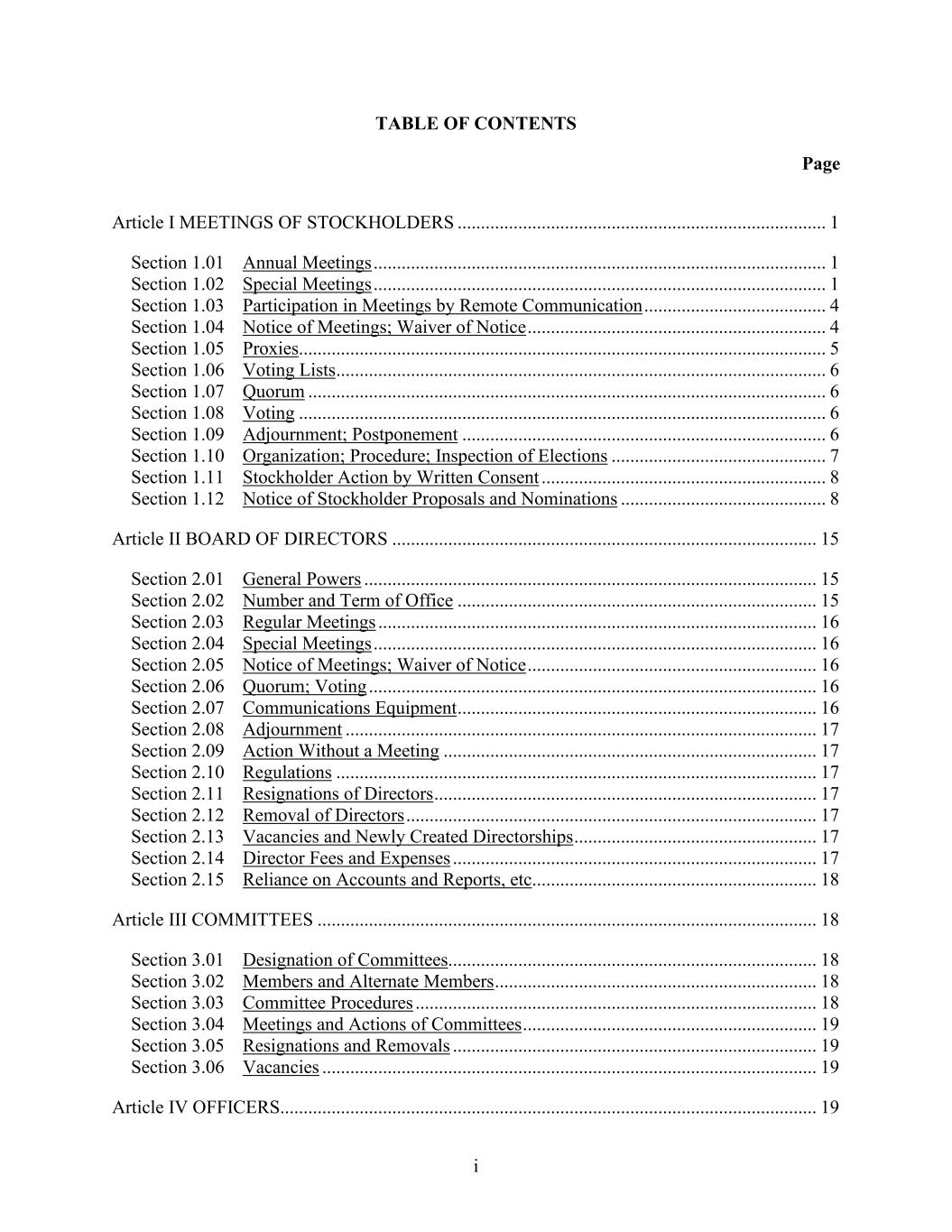
i TABLE OF CONTENTS Page Article I MEETINGS OF STOCKHOLDERS ............................................................................... 1 Section 1.01 Annual Meetings ................................................................................................. 1 Section 1.02 Special Meetings ................................................................................................. 1 Section 1.03 Participation in Meetings by Remote Communication ....................................... 4 Section 1.04 Notice of Meetings; Waiver of Notice ................................................................ 4 Section 1.05 Proxies................................................................................................................. 5 Section 1.06 Voting Lists ......................................................................................................... 6 Section 1.07 Quorum ............................................................................................................... 6 Section 1.08 Voting ................................................................................................................. 6 Section 1.09 Adjournment; Postponement .............................................................................. 6 Section 1.10 Organization; Procedure; Inspection of Elections .............................................. 7 Section 1.11 Stockholder Action by Written Consent ............................................................. 8 Section 1.12 Notice of Stockholder Proposals and Nominations ............................................ 8 Article II BOARD OF DIRECTORS ........................................................................................... 15 Section 2.01 General Powers ................................................................................................. 15 Section 2.02 Number and Term of Office ............................................................................. 15 Section 2.03 Regular Meetings .............................................................................................. 16 Section 2.04 Special Meetings ............................................................................................... 16 Section 2.05 Notice of Meetings; Waiver of Notice .............................................................. 16 Section 2.06 Quorum; Voting ................................................................................................ 16 Section 2.07 Communications Equipment ............................................................................. 16 Section 2.08 Adjournment ..................................................................................................... 17 Section 2.09 Action Without a Meeting ................................................................................ 17 Section 2.10 Regulations ....................................................................................................... 17 Section 2.11 Resignations of Directors .................................................................................. 17 Section 2.12 Removal of Directors ........................................................................................ 17 Section 2.13 Vacancies and Newly Created Directorships .................................................... 17 Section 2.14 Director Fees and Expenses .............................................................................. 17 Section 2.15 Reliance on Accounts and Reports, etc............................................................. 18 Article III COMMITTEES ........................................................................................................... 18 Section 3.01 Designation of Committees............................................................................... 18 Section 3.02 Members and Alternate Members ..................................................................... 18 Section 3.03 Committee Procedures ...................................................................................... 18 Section 3.04 Meetings and Actions of Committees ............................................................... 19 Section 3.05 Resignations and Removals .............................................................................. 19 Section 3.06 Vacancies .......................................................................................................... 19 Article IV OFFICERS................................................................................................................... 19
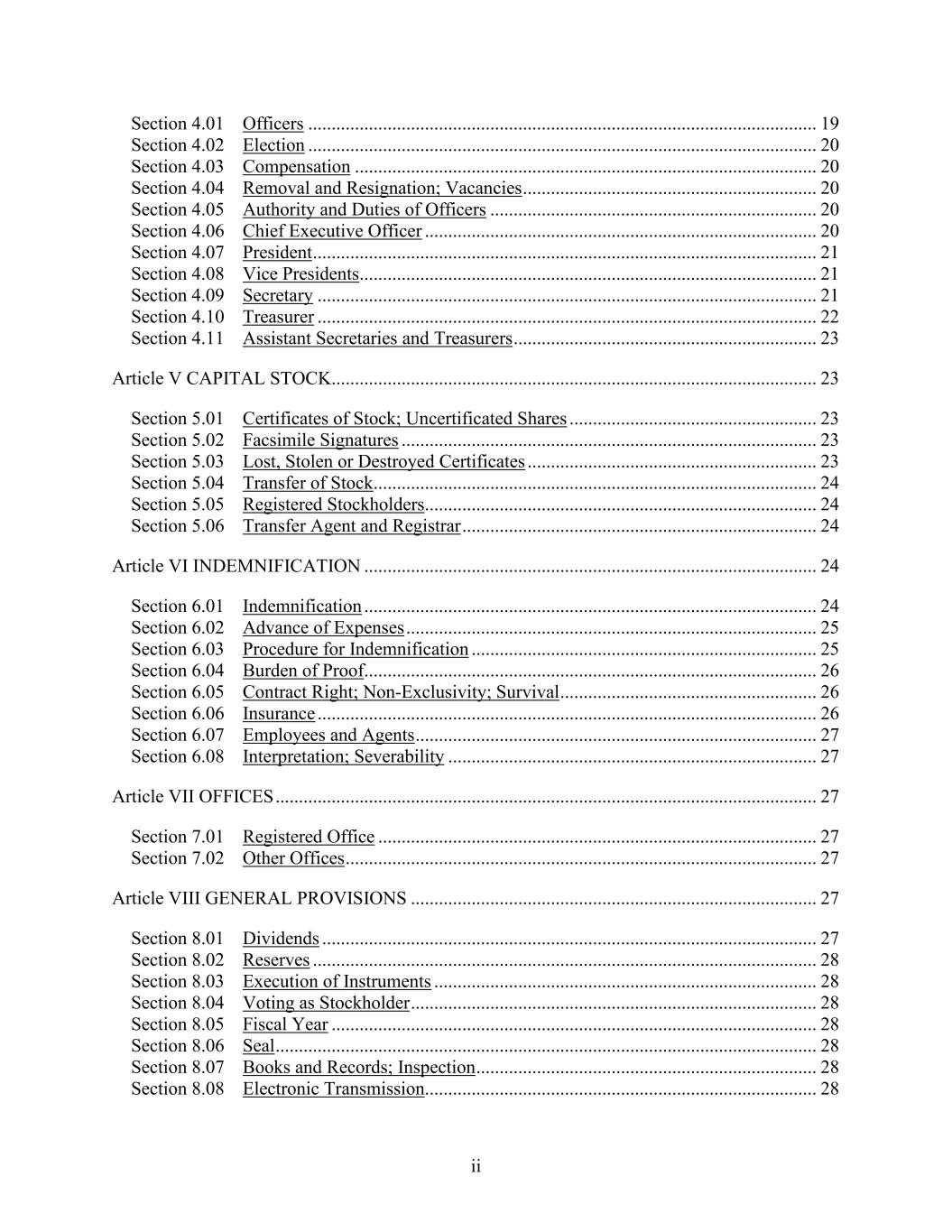
ii Section 4.01 Officers ............................................................................................................. 19 Section 4.02 Election ............................................................................................................. 20 Section 4.03 Compensation ................................................................................................... 20 Section 4.04 Removal and Resignation; Vacancies ............................................................... 20 Section 4.05 Authority and Duties of Officers ...................................................................... 20 Section 4.06 Chief Executive Officer .................................................................................... 20 Section 4.07 President ............................................................................................................ 21 Section 4.08 Vice Presidents.................................................................................................. 21 Section 4.09 Secretary ........................................................................................................... 21 Section 4.10 Treasurer ........................................................................................................... 22 Section 4.11 Assistant Secretaries and Treasurers ................................................................. 23 Article V CAPITAL STOCK........................................................................................................ 23 Section 5.01 Certificates of Stock; Uncertificated Shares ..................................................... 23 Section 5.02 Facsimile Signatures ......................................................................................... 23 Section 5.03 Lost, Stolen or Destroyed Certificates .............................................................. 23 Section 5.04 Transfer of Stock............................................................................................... 24 Section 5.05 Registered Stockholders.................................................................................... 24 Section 5.06 Transfer Agent and Registrar ............................................................................ 24 Article VI INDEMNIFICATION ................................................................................................. 24 Section 6.01 Indemnification ................................................................................................. 24 Section 6.02 Advance of Expenses ........................................................................................ 25 Section 6.03 Procedure for Indemnification .......................................................................... 25 Section 6.04 Burden of Proof................................................................................................. 26 Section 6.05 Contract Right; Non-Exclusivity; Survival ....................................................... 26 Section 6.06 Insurance ........................................................................................................... 26 Section 6.07 Employees and Agents ...................................................................................... 27 Section 6.08 Interpretation; Severability ............................................................................... 27 Article VII OFFICES .................................................................................................................... 27 Section 7.01 Registered Office .............................................................................................. 27 Section 7.02 Other Offices ..................................................................................................... 27 Article VIII GENERAL PROVISIONS ....................................................................................... 27 Section 8.01 Dividends .......................................................................................................... 27 Section 8.02 Reserves ............................................................................................................ 28 Section 8.03 Execution of Instruments .................................................................................. 28 Section 8.04 Voting as Stockholder ....................................................................................... 28 Section 8.05 Fiscal Year ........................................................................................................ 28 Section 8.06 Seal .................................................................................................................... 28 Section 8.07 Books and Records; Inspection ......................................................................... 28 Section 8.08 Electronic Transmission.................................................................................... 28
iii Article IX AMENDMENT OF BYLAWS ................................................................................... 28 Section 9.01 Amendment ....................................................................................................... 28
BOOZ ALLEN HAMILTON HOLDING CORPORATION AMENDED AND RESTATED BYLAWS As adopted on October 21, 2026 ARTICLE I MEETINGS OF STOCKHOLDERS Section 1.01 Annual Meetings. The annual meeting of the stockholders of the Booz Allen Hamilton Holding Corporation (the “Corporation”) for the election of directors (each, a “Director”) and for the transaction of such other business as properly may come before such meeting shall be held each year either within or without the State of Delaware at such place, if any, or by means of remote communication, and on such date and at such time, as may be fixed from time to time by resolution of the Corporation’s board of Directors (the “Board”) and set forth in the notice or waiver of notice of the meeting, unless, subject to Section 1.11 of these bylaws and the certificate of incorporation of the Corporation, the stockholders have acted by written consent to elect Directors as permitted by the General Corporation Law of the State of Delaware, as amended from time to time (the “DGCL”). Section 1.02 Special Meetings. (a) A special meeting of the stockholders for any purpose may be called at any time by or at the direction of the Board pursuant to a resolution of the Board adopted by a majority of the total number of Directors then in office. Any special meeting of the stockholders called pursuant to this Section 1.02(a) shall be held at such place, if any, within or without the State of Delaware, or by means of remote communication, and on such date and at such time, as shall be specified in such resolution. (b) A special meeting of the stockholders shall be called by or at the direction of the Board upon the written request to the Secretary of the Corporation (a “Special Meeting Request”) of one or more holders of common stock of the Corporation (“Common Stock”) owning not less than 25% (in the aggregate) of the outstanding shares of Common Stock (the “Requisite Ownership Percentage”) as of the date of such request and who have complied with the requirements set forth in Section 1.02(c) of these bylaws (such date, the “Special Meeting Request Date”). Business transacted at any special meeting of stockholders called pursuant to this Section 1.02(b) (a “Stockholder Requested Special Meeting”) shall be limited to (i) the purpose(s) stated in the valid Special Meeting Request and (ii) any additional matters that the Board determines to include in the Corporation’s notice of the special meeting. Any Stockholder Requested Special Meeting called pursuant to this Section 1.02(b) shall be held at such place, if any, within or without the State of Delaware, or by means of remote communication, and on such date and at such time, as the Board shall fix. For purposes of this Section 1.02(b), a stockholder shall be deemed to own only those shares of Common Stock as to which such person possesses both (1) the full voting and investment rights pertaining to such shares and (2) the full economic interest in such shares; provided that the number of shares calculated in accordance with the foregoing clauses (1) and (2) of this Section 1.02(b) shall not include any shares of Common Stock (x) sold by such stockholder or any of its affiliates (as defined in Rule 12b-2 under the Securities Exchange Act of 1934, as
2 amended (the “Exchange Act”)) in any transaction that has not been settled or closed, (y) borrowed by such stockholder or any of its affiliates for any purposes or purchased by such stockholder or any of its affiliates pursuant to an agreement to resell or (z) subject to any option, warrant, forward, contract, swap, contract of sale, or other derivative or similar agreement entered into by such stockholder or any of its affiliates, whether any such instrument or agreement is to be settled with shares of Common Stock or with cash based on the notional amount or value of shares of Common Stock, in any case which instrument or agreement has, or is intended to have, or if exercised would have the purpose or effect of (A) reducing in any manner, to any extent or at any time in the future, such stockholder’s or affiliate’s full right to vote or direct the voting of any such shares or (B) hedging, offsetting or altering to any degree any gain or loss arising from the full economic ownership of such shares by such stockholder or affiliate. The determination as to whether a stockholder owns any shares of Common Stock for these purposes shall be made at the sole discretion of, and in good faith by, the Board, which determination shall be conclusive and binding on the Corporation and the stockholders. (c) A Special Meeting Request shall not be valid, and a Stockholder Requested Special Meeting shall not be held, unless the Special Meeting Request: (i) is signed and dated by one or more stockholders that own, in the aggregate, the Requisite Ownership Percentage; (ii) is accompanied by: 1. a brief description of each matter of business desired to be brought before the Stockholder Requested Special Meeting and the reasons for conducting such business at the Stockholder Requested Special Meeting; 2. the text of the proposal or business (including, without limitation, the text of any resolutions proposed for consideration, which shall not exceed 500 words, and in the event that such business includes a proposal to amend the certificate of incorporation and/or these bylaws, the language of the proposed amendment); 3. documentary evidence that such stockholder owns shares of Common Stock that represent no less than the Requisite Ownership Percentage as of the Special Meeting Request Date; 4. an agreement to (A) continue to own such number of shares of Common Stock representing no less than the Requisite Ownership Percentage through the date of the Stockholder Requested Special Meeting (provided, that the Board shall have the discretion to cancel such Stockholder Requested Special Meeting if the requesting stockholders fail to collectively satisfy this ownership requirement at any time during the period beginning on the expiration of the Special Meeting Request Window and ending upon the conclusion of matters and business at the respective Stockholder Requested Special Meeting) and (B) promptly update and supplement the information provided in the Special Meeting Request to the extent necessary so that the information provided therein is true and correct as of the record date for the Stockholder Requested Special Meeting (such update and supplement to be delivered to the Secretary at the
3 principal place of business of the Corporation not later than five days after the record date for the Stockholder Requested Special Meeting) and as of the date that is no more than 10 days prior to the date of the Stockholder Requested Special Meeting (such update and supplement to be delivered to the Secretary of the Corporation at the principal place of business of the Corporation not later than five days prior to the date of such Stockholder Requested Special Meeting); and 5. if the purpose of the Stockholder Requested Special Meeting includes the election of one or more Directors, the information, statements, representations, agreements and other documents that would be required to be set forth in or included with a stockholder’s notice of a nomination pursuant to paragraphs (iii) and (iv) of Section 1.12(a) of these bylaws; (iii) does not relate to any item of business that (1) is the same as, or substantially similar (as determined in good faith by the Board) to, any item of business that stockholders of the Corporation voted on at a meeting of stockholders that occurred (x) within 120 days preceding the Special Meeting Request Date, if such item involves the election of Directors, or (y) within 12 months preceding the Special Meeting Request Date, for all other items (and, for purposes of this clause (iii), the election of Directors shall be deemed “similar” to any item of business involving the election of Directors, the removal of Directors or the size of the Board) or (2) is not a proper subject for stockholder action under applicable law (as determined in good faith by the Board); and (iv) is received by the Secretary of the Corporation more than 90 days before the earlier of (1) the date of the Corporation’s next annual meeting of stockholders, to the extent such date has been publicly announced by the Corporation prior to the Special Meeting Request Date, and (2) the first anniversary of the preceding year’s annual meeting of stockholders. One or more written requests for a special meeting delivered to the Secretary of the Corporation shall constitute a valid Special Meeting Request only if each such written request (x) satisfies the requirements of this Section 1.02(c), (y) is materially consistent in all respects with each other written request, including, without limitation, by identifying substantially the same purpose or purposes of the Stockholder Requested Special Meeting and (z) has been dated and delivered to the Secretary of the Corporation at the principal place of business of the Corporation within 60 days of the earliest dated of such requests (the “Special Meeting Request Window”). The Board shall determine, in its sole discretion and in good faith, the validity of any Special Meeting Request, and its determination shall be conclusive and binding on the Corporation and the stockholders. Any written request that the Board determines in good faith does not satisfy the foregoing requirements shall be disregarded and shall not be counted in determining whether the Requisite Ownership Percentage has been satisfied. (d) A stockholder’s Special Meeting Request shall be deemed revoked with respect to (i) all shares of Common Stock owned by such stockholder as of the date of the Special Meeting Request if such stockholder does not (1) appear at the Stockholder Requested Special Meeting to present the matters to be brought before the special meeting as specified in the Special Meeting Request or (2) promptly update and supplement the information provided in the Special Meeting Request in accordance with Section 1.02(c)(ii)(4)(B), and (ii) the shares of Common
4 Stock comprising any reduction in the number of shares of Common Stock owned by such stockholder at any time prior to the conclusion of matters and business at the respective Stockholder Requested Special Meeting as compared to the number of shares of Common Stock owned by such stockholder as of the Special Meeting Request Date. (e) Any stockholder who submitted a Special Meeting Request may revoke his, her or its Special Meeting Request at any time by written revocation delivered to the Secretary of the Corporation at the principal place of business of the Corporation. If, following a revocation (whether by specific written revocation or deemed revocation pursuant to Section 1.02(d)) and the expiration of the Special Meeting Request Window, the unrevoked portion of a valid Special Meeting Request represents ownership of less than the Requisite Ownership Percentage, then such stockholder or stockholders, as applicable, shall be deemed to have withdrawn such Special Meeting Request in its entirety and the Board shall have the discretion to determine whether or not to proceed with the Stockholder Requested Special Meeting and there shall be no requirement for the Board to call, or for the Corporation to hold, a Stockholder Requested Special Meeting, regardless of whether notice of such special meeting has been sent, a record date has been fixed or proxies have been solicited for such special meeting. Section 1.03 Participation in Meetings by Remote Communication. The Board, acting in its sole discretion, may establish guidelines and procedures in accordance with applicable provisions of the DGCL and any other applicable law for the participation by stockholders and proxyholders in a meeting of stockholders by means of remote communications, and may determine that any meeting of stockholders will not be held at any place but will be held solely by means of remote communication. Stockholders and proxyholders complying with such procedures and guidelines and otherwise entitled to vote at a meeting of stockholders shall be deemed present in person and entitled to vote at a meeting of stockholders, whether such meeting is to be held at a designated place or solely by means of remote communication. Section 1.04 Notice of Meetings; Waiver of Notice. (a) The Secretary or any Assistant Secretary shall cause notice of each meeting of stockholders to be given in a manner permitted by the DGCL not less than 10 days nor more than 60 days prior to the meeting to each stockholder of record entitled to vote at such meeting, subject to such exclusions as are then permitted by the DGCL. The notice shall specify (i) the place, if any, date and time of such meeting, (ii) the means of remote communications, if any, by which stockholders and proxy holders may be deemed to be present in person and vote at such meeting, (iii) the record date for determining the stockholders entitled to vote at the meeting (if such date is different from the record date for stockholders entitled to notice of the meeting), (iv) in the case of a special meeting, the purpose or purposes for which such meeting is called and (v) such other information as may be required by law or as may be deemed appropriate by the Board, the President, the Chief Executive Officer or the Secretary of the Corporation. If the stockholder list referred to in Section 1.06 of these bylaws is made accessible on an electronic network, the notice of meeting must indicate how the stockholder list can be accessed. If notice of a meeting is transmitted electronically, the notice shall be deemed given when directed to the stockholder’s electronic mail address as supplied by the stockholder to the Secretary of the Corporation or as otherwise directed pursuant to the stockholder’s authorization or instructions. A determination of stockholders of record entitled to notice of or to vote at a meeting of stockholders shall apply to
5 any adjournment or recess of the meeting; provided, however, that the Board may fix a new record date for determination of stockholders entitled to vote at the adjourned or recessed meeting, and in such case shall also fix as the record date for stockholders entitled to notice of such adjourned or recessed meeting the same date as that fixed for determination of stockholders entitled to vote in accordance herewith at the adjourned or recessed meeting. (b) A written waiver of notice of meeting signed by a stockholder or a waiver by electronic transmission by a stockholder, whether given before or after the meeting time stated in such notice, is deemed equivalent to notice. Neither the business to be transacted at, nor the purpose of, any regular or special meeting of the stockholders need be specified in a waiver of notice. Attendance of a stockholder at a meeting is a waiver of notice of such meeting, except when the stockholder attends a meeting for the express purpose of objecting at the beginning of the meeting to the transaction of any business at the meeting on the ground that the meeting is not lawfully called or convened. Section 1.05 Proxies. (a) Each stockholder entitled to vote at a meeting of stockholders or to express consent to or dissent from corporate action in writing without a meeting may authorize another person or persons to act for such stockholder by proxy. (b) A stockholder may authorize a valid proxy by executing a written instrument signed by such stockholder, or by causing his or her signature to be affixed to such writing by any reasonable means, including, without limitation, by facsimile signature, or by transmitting or authorizing an electronic transmission (as defined in Section 8.08 of these bylaws) setting forth an authorization to act as proxy to the person designated as the holder of the proxy, a proxy solicitation firm or a like authorized agent. Proxies by electronic transmission must either set forth, or be submitted with, information from which it can be determined that the electronic transmission was authorized by the stockholder. Any copy, facsimile telecommunication or other reliable reproduction of a writing or transmission created pursuant to this section may be substituted or used in lieu of the original writing or transmission for any and all purposes for which the original writing or transmission could be used if such copy, facsimile telecommunication or other reproduction is a complete reproduction of the entire original writing or transmission. (c) No proxy may be voted or acted upon after the expiration of three years from the date of such proxy, unless such proxy provides for a longer period. Every proxy is revocable at the pleasure of the stockholder providing it unless the proxy states that it is irrevocable and applicable law makes it irrevocable. A stockholder may revoke any proxy that is not irrevocable by attending the meeting and voting in person or by filing an instrument in writing revoking the proxy or by filing another duly executed proxy bearing a later date with the Secretary. (d) Any stockholder or beneficial owner, if any, or any Stockholder Associated Person (as defined in Section 1.12), other than a stockholder acting on behalf of the Board, directly or indirectly soliciting proxies from other stockholders must use a proxy card color other than white, which shall be reserved for the exclusive use by the Corporation.
6 Section 1.06 Voting Lists. The officer of the Corporation who has charge of the stock ledger of the Corporation shall prepare, at least 10 days before every meeting of the stockholders (and before any adjournment or postponement thereof for which a new record date has been set), a complete list of the stockholders of record entitled to vote at the meeting, arranged in alphabetical order and showing the address of each stockholder and the number of shares registered in the name of each stockholder. This list, which may be in any format including, without limitation, electronic format, shall be open to the examination of any stockholder prior to the meeting for any purpose germane to the meeting in the manner required by the DGCL and other applicable law, for a period of at least 10 days ending on the day before the meeting date. The stock ledger shall be the only evidence as to who are the stockholders entitled by this section to examine the list required by this section or entitled to vote in person or by proxy at any meeting of stockholders. Section 1.07 Quorum. Except as otherwise provided in the certificate of incorporation or by law, the presence in person or by proxy of the holders of record of a majority of the shares entitled to vote at a meeting of stockholders shall constitute a quorum for the transaction of business at such meeting, provided, however, that where a separate vote by a class or series is required, the holders of a majority in voting power of all issued and outstanding stock of such class or series entitled to vote on such matter, present in person or represented by proxy, shall constitute a quorum entitled to take action with respect to such matter. In the absence of a quorum, the stockholders so present may, by a majority in voting power thereof, adjourn the meeting from time to time in the manner provided in Section 1.09 of these bylaws until a quorum shall attend. Section 1.08 Voting. Except as otherwise provided in the certificate of incorporation or by law, every holder of record of shares entitled to vote at a meeting of stockholders is entitled to one vote for each share outstanding in his or her name on the books of the Corporation (x) at the close of business on the record date for such meeting, or (y) if no record date has been fixed, at the close of business on the day next preceding the day on which notice of the meeting is given, or if notice is waived, at the close of business on the day next preceding the day on which the meeting is held. Except as otherwise required by law, the certificate of incorporation, these bylaws, the rules and regulations of any stock exchange applicable to the Corporation or pursuant to any other rule or regulation applicable to the Corporation or its stockholders, the vote of a majority of the shares entitled to vote at a meeting of stockholders on the subject matter in question represented in person or by proxy at any meeting at which a quorum is present shall be sufficient for the transaction of any business at such meeting. The stockholders do not have the right to cumulate their votes for the election of Directors. Section 1.09 Adjournment; Postponement. Any meeting of stockholders may be adjourned, for any reason, or without reason, from time to time (including, without limitation, to address a technical failure to convene or continue a meeting using remote communication), if a quorum is (1) present, solely by the Board or the chairperson of the meeting or (2) not present, solely by the Board, chairperson of the meeting, or by a vote of a majority of the shares of stock present in person or represented by proxy at the meeting, to reconvene at the same or some other place. The Board may postpone or reschedule any previously scheduled meeting of the stockholders. Notice need not be given of any such adjourned or postponed meeting if the place, if any, and date and time thereof (and the means of remote communication, if any, by which stockholders and proxy holders may be deemed to be present in person and vote at such meeting) are (i) announced at the meeting at which the adjournment or postponement is taken, (ii) displayed,
7 during the time scheduled for the meeting, on the same electronic network, if any, used to enable stockholders and proxy holders to participate in the meeting by means of remote communication or (iii) set forth in the notice of meeting given in accordance with Section 1.04 of these bylaws, unless the adjournment or postponement is for more than 30 days or a new record date is fixed for the adjourned or postponed meeting after the adjournment or postponement, in which case notice of the adjourned or postponed meeting in accordance with Section 1.04 of these bylaws shall be given to each stockholder of record entitled to vote at the meeting. At the adjourned or postponed meeting, the Corporation may transact any business that might have been transacted at the original meeting. Section 1.10 Organization; Procedure; Inspection of Elections. (a) At every meeting of stockholders the presiding officer shall be the Chairman of the Board, or in the event of his or her absence or disability, a presiding officer chosen by resolution of the Board. The Secretary, or in the event of his or her absence or disability, the Assistant Secretary, if any, or if there be no Assistant Secretary, in the absence of the Secretary, an appointee of the presiding officer, shall act as secretary of the meeting. The Board may make such rules or regulations for the conduct of meetings of stockholders as it shall deem necessary, appropriate or convenient. Subject to any such rules and regulations, the presiding officer of any meeting shall have the right and authority to prescribe rules, regulations and procedures for such meeting and to take all such actions as in the judgment of the presiding officer are appropriate for the proper conduct of such meetings. Such rules, regulations or procedures, whether adopted by the Board or prescribed by the presiding officer of the meeting, may include, without limitation, the following: (i) the establishment of an agenda or order of business for the meeting; (ii) rules and procedures for maintaining order at the meeting and the safety of those present; (iii) limitations on attendance at or participation in the meeting to stockholders of record of the Corporation, their duly authorized and constituted proxies or such other persons as the presiding person of the meeting shall determine; (iv) restrictions on entry to the meeting after the time fixed for the commencement thereof; (v) restrictions on the use of any audio or video recording devices at the meeting; and (vi) limitations on the time allotted to questions or comments by participants. The presiding officer at any meeting of stockholders, in addition to making any other determinations that may be appropriate to the conduct of the meeting, shall, if the facts warrant, determine and declare to the meeting that a matter or business was not properly brought before the meeting and if such presiding person should so determine, such presiding person shall so declare to the meeting and any such matter of business not properly brought before the meeting shall not be transacted or considered. Unless and to the extent determined by the Board or the person presiding over the meeting, meetings of stockholders shall not be required to be held in accordance with the rules of parliamentary procedure. (b) Preceding any meeting of the stockholders, the Board may, and when required by law shall, appoint one or more persons to act as inspectors of elections, and may designate one or more alternate inspectors. If no inspector or alternate so appointed by the Board is able to act, or if no inspector or alternate has been appointed and the appointment of an inspector is required by law, the person presiding at the meeting shall appoint one or more inspectors to act at the meeting. None of the following persons shall be appointed as an inspector of elections: (i) any stockholder making a nomination or proposal at the meeting pursuant to Section 1.12 of these bylaws; (ii) any affiliate (as defined in Rule 12b-2 under the Exchange Act) of such stockholder;
8 (iii) any Director; or (iv) any nominee for the office of Director. Each inspector, before entering upon the discharge of the duties of an inspector, shall take and sign an oath faithfully to execute the duties of inspector with strict impartiality and according to the best of his or her ability. The inspectors shall discharge their duties in accordance with the requirements of applicable law. Section 1.11 Stockholder Action by Written Consent. Except as otherwise provided in the certificate of incorporation, any action required or permitted to be taken at any annual or special meeting of stockholders of the Corporation shall be taken only upon the vote of the stockholders at an annual or special meeting duly called and shall not be taken by written consent of the stockholders. Section 1.12 Notice of Stockholder Proposals and Nominations. (a) Annual Meetings. (i) Nominations of persons for election to the Board and proposals of business to be considered by the stockholders at an annual meeting of stockholders shall be made only (x) as specified in the Corporation’s notice of meeting (or any notice supplemental thereto), (y) by or at the direction of the Board, or a committee appointed by the Board for such purpose, or (z) by any stockholder of the Corporation who or which (1) is entitled to vote at the meeting, (2) complies in a timely manner with all notice procedures set forth in this Section 1.12, and (3) is a stockholder of record when the required notice is delivered and through the date of the meeting. A stockholder proposal must constitute a proper matter for corporate action under the DGCL. (ii) Notice in writing of a stockholder nomination or stockholder proposal must be delivered to the Secretary at the principal place of business of the Corporation by the close of business not fewer than 90 days nor more than 120 days prior to the first anniversary of the preceding year’s annual meeting of stockholders; provided that if the date of the annual meeting is advanced by more than 30 days or delayed by more than 70 days from such anniversary date of the preceding year’s annual meeting, notice by the stockholder to be timely must be so delivered not earlier than 120 days prior to such annual meeting and not later than the close of business on the later of the 90th day prior to such annual meeting or the close of business on the 10th day following the day on which public announcement of the date of such meeting is first made. The number of nominees a stockholder of record may nominate for election at the annual meeting (or in the case of one or more stockholder(s) of record giving the notice on behalf of a beneficial owner, may collectively nominate for election at the annual meeting on behalf of such beneficial owner) shall not exceed the number of Directors to be elected at such annual meeting. (iii) Notice of a stockholder nomination shall include, as to each person whom the stockholder of record proposes to nominate for election or re-election as a Director, (i) all information relating to such person required to be disclosed in solicitations of proxies in a contest for election of Directors or is otherwise required, in each case pursuant to and in accordance with Section 14(a) of the Exchange Act, and the rules and regulations promulgated thereunder (including, without limitation, Rules 14a-9 and 14a-19), (ii) a written representation and agreement, signed by such person, pursuant to which such person shall represent and agree that such person consents to being named in the proxy statement and accompanying proxy card as a nominee, and currently intends to serve as a Director for the full term for which such person is standing for election, (iii) a
9 written representation that such person will, consent to a customary background check, and will comply with all applicable policies of the Corporation, (iv) a written representation that such person has obtained all required third-party consents to serve on the Board if elected, including, without limitation, from any other public company board of directors on which such person serves, if applicable, (v) a description of any material pending or threatened legal proceeding in which such person is a party or material participant involving the Corporation or any of its officers or directors, or any affiliate of the Corporation, (vi) a description of any interest in the securities of the Corporation held by a general or limited partnership or similar entity in which such person is a general partner or beneficially owns an interest in a general partner of such partnership or is the manager, managing member or beneficially owns an interest in the manager or managing member of a similar entity, (vii) a description of any material relationship or any direct or indirect compensatory, payment or other financial agreement, arrangement or understanding, whether written or oral, by and between all persons whom the stockholder of record proposes to nominate for election or re-election as a Director, (viii) a questionnaire completed and signed by such person (which questionnaire shall be provided by the Secretary of the Corporation upon written request of any stockholder of record within 10 days of such request) with respect to the background, experience, qualification, security ownership and independence of such proposed nominee, the background of any other person or entity on whose behalf the nomination is being made and any other information requested by the Corporation relating to laws, rules and regulations applicable to the Corporation, (ix) a description of any officer or director positions held at any competitors of the Corporation within the last three years, and (x) a written representation and agreement (in the form provided by the Secretary of the Corporation upon written request of any stockholder of record within 10 days of such request) that such person (A) is not and will not become a party to (1) any agreement, arrangement or understanding with, and has not given any commitment or assurance to, any person or entity as to how such person, if elected as a director of the Corporation, will act or vote on any issue or question (a “Voting Commitment”) that has not been disclosed to the Corporation or (2) any Voting Commitment that could limit or interfere with such person’s ability to comply, if elected as a director of the Corporation, with such person’s fiduciary duties under applicable law, (B) is not and will not become a party to any agreement, arrangement or understanding with any person or entity other than the Corporation with respect to any direct or indirect compensation, reimbursement or indemnification in connection with service or action as a director that has not been disclosed to the Corporation, (C) in such person’s individual capacity, would be in compliance, if elected as a director of the Corporation, and will comply with all applicable publicly disclosed corporate governance, conflict of interest, confidentiality and stock ownership and trading policies and guidelines of the Corporation and (D) acknowledges that a material breach of any of the foregoing will constitute grounds for the Corporation not to accept such person’s nomination. Notice of a stockholder proposal shall include a brief description of the business desired to be brought before the meeting, the text of the proposal (including, without limitation, the text of any resolutions, which shall not exceed 500 words, proposed for consideration and if such business includes proposed amendments to the certificate of incorporation and/or these bylaws of the Corporation, the text of the proposed amendments), the reasons for conducting such business at the meeting and any material interest in such business of such stockholder of record and the beneficial owner and any of their affiliates or associates (each as defined in Rule 12b-2 under the Exchange Act), or other person acting in concert therewith, if any, on whose behalf the proposal is made.
10 (iv) Notice of a stockholder nomination or proposal shall also set forth, as to the stockholder of record giving the notice and the beneficial owner, if any, on whose behalf the nomination or proposal is made (including, without limitation, any person or entity that would be considered to be a member of a “group” (as such term is used in Rule 13d-5 of the Exchange Act) with the stockholder of record or beneficial owner on whose behalf the nomination or proposal is made): 1. the name and address of such stockholder of record, as they appear on the Corporation’s books and records, and of such beneficial owner; 2. the class or series and number of shares of capital stock of the Corporation which are owned beneficially and of record by such stockholder of record and such beneficial owner; 3. a description of any material relationship or any agreement, arrangement or understanding, whether written or oral, (x) entered into in connection with the proposal of such nomination or other business or (y) pursuant to which any financial assistance, funding or other consideration is received with respect to the investment by such stockholder of record or beneficial owner in the Corporation, in each case, between or among such stockholder of record, any such beneficial owner, any of their respective affiliates or associates, any person or entity controlling, directly or indirectly, or acting in concert, solely with respect to the nomination or proposal of the Corporation, with such stockholder of record (each of the foregoing, a “Stockholder Associated Person”), and any other person or persons (including their names), including, without limitation, all items that would be required to be disclosed pursuant to Item 404 under Regulation S-K if such stockholder of record giving the notice, such beneficial owner or such Stockholder Associated Person were a “registrant” for purposes of such rule and the proposed nominee were a director or executive officer of such registrant; 4. a description of any agreement, arrangement or understanding (including, without limitation and regardless of the form of settlement, any derivative, long or short positions, profit interests, forwards, futures, swaps, options, warrants, convertible securities, stock appreciation or similar rights, hedging transactions and borrowed or loaned shares) that has been entered into by or on behalf of such stockholder of record and/or such beneficial owner, or any other agreement, arrangement or understanding that has been made, the effect or intent of which is to create or mitigate loss to, manage risk or benefit of share price changes for, or increase or decrease the voting power of, such stockholder of record or any such beneficial owner or any such nominee with respect to the Corporation’s securities (a “Derivative Instrument”); 5. to the extent not disclosed pursuant to clause (4) above, the principal amount of any indebtedness of the Corporation or any of its subsidiaries beneficially owned by such stockholder of record or by any such beneficial owner, together with the title of the instrument under which such indebtedness was issued and a description of any Derivative Instrument entered into by or on behalf of such stockholder of record or such beneficial owner relating to the value or payment of any indebtedness of the Corporation or any such subsidiary;
11 6. a statement indicating whether any Stockholder Associated Person will make any other nomination or proposal at the annual meeting; 7. a description of any interest in the Corporation’s securities held by a general or limited partnership or similar entity in which the nominee is a general partner or beneficially owns an interest in a general partner of such partnership or is the manager, managing member or beneficially owns an interest in the manager or managing member of a similar entity; 8. all other information relating to such stockholder, such beneficial owner, if any, and such Stockholder Associated Person, if any, required to be disclosed in a proxy statement or other filing required to be made in connection with solicitations of proxies for, as applicable, the proposal and/or for the election of directors in an election contest pursuant to and in accordance with Section 14(a) of the Exchange Act; provided, that, for purposes of these bylaws, each such beneficial owner and Stockholder Associated Person shall be deemed a “participant” in such solicitations; 9. all other information relating to such stockholder and such beneficial owner, if any, and such Stockholder Associated Person, if any (including, without limitation, information with respect to any person or entity who would be deemed a member of a “group” (as defined under Rule 13d-5(b) under the Exchange Act) with such stockholder and such beneficial owner, if any) that would be required to be disclosed in a Schedule 13D filed pursuant to Rule 13d-1(a) under the Exchange Act or an amendment pursuant to Rule 13d-2(a) under the Exchange Act as if such a Schedule 13D were required to be filed under the Exchange Act by such stockholder or such beneficial owner; 10. a representation that the stockholder is a holder of record of stock of the Corporation entitled to vote at such meeting and intends to appear in person or by proxy at the meeting to propose such business or nomination; 11. a representation as to whether the stockholder of record, the beneficial owner, or any Stockholder Associated Person, if any, intends or is part of a group which intends (x) to deliver a proxy statement and/or form of proxy to holders of at least the percentage of the Corporation’s outstanding capital stock required to elect the nominee or to approve or adopt the proposal, (y) otherwise to solicit proxies from stockholders in support of such nomination or proposal and (z) to solicit proxies in support of any proposed nominee in accordance with Rule 14a-19 promulgated under the Exchange Act; and 12. to the extent known by the stockholder of record, the names and addresses of any other stockholders (including, without limitation, beneficial owners) of the Corporation known to be providing financial support or meaningful assistance in furtherance of such nomination or proposal. A stockholder of record providing notice of any nomination proposed to be made at a meeting shall notify the Corporation promptly, and in any event within two business days, after it becomes
12 aware of any change in the information provided or required to be provided in such notice pursuant to this Section 1.12(a); it being understood that providing any such update or supplement shall not be deemed to cure any defect in the stockholder’s notice, extend any applicable deadlines under these bylaws, permit the inclusion of any new nominees or substitute nominees who were not named in the original stockholder notice, or otherwise limit the Corporation’s right to exclude any business proposal or nominee from the meeting on account of such defect. All information provided in the stockholder’s notice must be true and correct in all material respects (or does not omit a material fact necessary to make the statements made not misleading) as of (x) the date of its initial submission to the Corporation, (y) the record date for stockholders entitled to vote at the meeting, and (z) the date that is 10 business days prior to the meeting or any adjournment or postponement (and any such information delivered in connection with (z) must be delivered to the Secretary of the Corporation at the principal place of business of the Corporation not later than eight business days prior to the meeting or any adjournment or postponement thereof), and any supplements to such initial stockholder’s notice shall be true, complete and correct as of the dates provided in the preceding sentence, and any update or supplement shall be made only to the extent that such information has changed since the stockholder’s prior submission of his or her notice. The foregoing notice requirements of this Section 1.12(a) shall be deemed satisfied by a stockholder with respect to business other than a nomination if the stockholder has notified the Corporation of his or her intention to present a proposal at an annual meeting in compliance with the applicable rules and regulations promulgated under the Exchange Act and such stockholder’s proposal has been included in a proxy statement that has been prepared by the Corporation to solicit proxies for such annual meeting. (b) Special Meetings. (i) Only such business shall be conducted at a special meeting of stockholders as shall have been brought before the meeting pursuant to the Corporation’s notice of meeting pursuant to Section 1.04 of these bylaws. Nominations of persons for election to the Board at a special meeting of stockholders may be made only (x) as specified in the Corporation’s notice of meeting (or any supplement thereto), (y) by or at the direction of the Board, or a committee appointed by the Board for such purpose, if the Corporation’s notice of meeting indicated that the purposes of meeting included the election of Directors and specified the number of Directors to be elected, or (z) subject to the provisions of these bylaws, by any stockholder of the Corporation. A stockholder may nominate persons for election to the Board (a “Stockholder Nomination”) at a special meeting only if the stockholder (1) has submitted a Special Meeting Request pursuant to Section 1.02(c) of these bylaws or (2) in the case of all other special meetings of stockholders, (A) is entitled to vote at the meeting, (B) complies in a timely manner with the notice procedures set forth in paragraph (ii) of this Section 1.12(b), and (C) is a stockholder of record when the required notice is delivered and through the date of the meeting. (ii) Notice in writing of a Stockholder Nomination must be delivered (i) in the case of a Stockholder Requested Special Meeting, in accordance with Section 1.02(c) of these bylaws or (ii) in the case of all other special meetings of stockholders, to the attention of the Secretary at the principal place of business of the Corporation not more than 120 days prior to the date of the meeting and not later than the close of business on the later of the 90th day prior to the meeting or the 10th day following the last to occur of the public announcement by the Corporation of the date of such meeting and the public announcement by the Corporation of the nominees
13 proposed by the Board to be elected at such meeting, and must comply with the provisions of Sections 1.12(a)(iii) and (iv) of these bylaws. Other than in the case of a Stockholder Requested Special Meeting, the foregoing notice requirements of this Section 1.12(b) shall be deemed satisfied by a stockholder with respect to a proposal other than a nomination if the stockholder has notified the Corporation of his or her intention to present a proposal other than a nomination at such special meeting in compliance with the applicable rules and regulations promulgated under the Exchange Act and such stockholder’s proposal has been included in a proxy statement that has been prepared by the Corporation to solicit proxies for such special meeting. (c) General. (i) Except as otherwise expressly provided in any applicable rule or regulation promulgated under the Exchange Act or these bylaws, only such persons who are nominated in accordance with the procedures set forth in this Section 1.12 shall be eligible to be elected at an annual or special meeting of stockholders of the Corporation to serve as directors and only such business shall be conducted at a meeting of stockholders as shall have been brought before the meeting in accordance with the procedures set forth in this Section 1.12. Except as otherwise provided by law, the certificate of incorporation or these bylaws, the presiding officer of a meeting of stockholders (and, in advance of any meeting of stockholders, the Board) shall have the power and duty (x) to make all necessary determinations relating to nominations of persons for election to the Board and the proposal of other business to be considered by the stockholders, including, without limitation, whether a nomination or any business proposed to be brought before the meeting was made in accordance with the procedures set forth in this Section 1.12, and (y) if any proposed nomination or business is not in compliance with this Section 1.12, to declare that such defective nomination shall be disregarded or that such proposed business shall not be transacted, notwithstanding that proxies in respect of such vote may have been received by the Corporation. (ii) The Corporation may require any proposed stockholder nominee for Director to furnish, including, without limitation, by way of interview, within 10 days of a request therefor, such other information as it may reasonably require, including, without limitation, to determine the independence of such proposed nominee or the eligibility of such proposed nominee to serve as a Director. If the stockholder of record (or a qualified representative of such stockholder) making a nomination or proposal under this Section 1.12 or Section 1.02 of these bylaws does not appear at a meeting of stockholders to present such nomination or proposal, the nomination shall be disregarded and/or the proposed business shall not be transacted, as the case may be, notwithstanding that proxies in favor thereof may have been received by the Corporation. For purposes of this Section 1.12, to be considered a qualified representative of the stockholder of record, a person must be a duly authorized officer, manager or partner of such stockholder or must be authorized by a writing executed by such stockholder or an electronic transmission delivered by such stockholder to act for such stockholder as proxy at the meeting of stockholders and such person must produce such writing or electronic transmission, or a reliable reproduction of the writing or electronic transmission, at the meeting of stockholders. Notwithstanding anything to the contrary in these bylaws, unless otherwise required by law, if any stockholder of record provides notice pursuant to Rule 14a-19(b) promulgated under the Exchange Act with respect to a proposed nominee and subsequently fails to comply with the requirements of Rule 14a-19(a)(2) or Rule 14a-19(a)(3) promulgated under the Exchange Act (or fails to timely provide reasonable
14 evidence sufficient to satisfy the Corporation that such stockholder has met the requirements of Rule 14a-19(a)(3) promulgated under the Exchange Act in accordance with this Section 1.12), then such stockholder’s nomination of each such proposed nominee shall be disregarded, notwithstanding that proxies or votes in respect of the election of such proposed nominees of such stockholder may have been received by the Corporation. A stockholder of record, beneficial owner, or Stockholder Associated Person must notify the Corporation if it no longer intends to solicit proxies in accordance with the representations it has made to the Corporation regarding proxy solicitation and compliance with Rule 14a-19 or otherwise fails to timely satisfy the requirements of Rule 14a-19. A stockholder may not present a nomination (and any nominee shall be disqualified from standing for election or re-election) if such stockholder of record, the beneficial owner on whose behalf such stockholder gave notice, or any Stockholder Associated Person or nominee breaches a representation required by these bylaws or fails to comply with the requirements set forth in this Section 1.12 or applicable law or provides incomplete, false or misleading information to the Corporation. If a stockholder or beneficial owner, if any, or any Stockholder Associated Person intends to solicit proxies in support of any director nominee other than the Corporation’s nominees, such person shall, in addition to the requirements of this Section 1.12, (a) deliver to the Corporation, no later than the earlier of the time provided in this Section 1.12 or the time provided in Rule 14a-19 of the Exchange Act, the notice and other information required in Rule 14a-19 of the Exchange Act and (b) shall deliver to the Corporation, no later than five business days prior to the applicable meeting, reasonable evidence that it has met the requirements of Rule 14a-19(a)(3) promulgated under the Exchange Act. (iii) For purposes of this Section 1.12, “public announcement” shall mean disclosure in a press release reported by the Dow Jones News Service, Associated Press or comparable national news service or in a document publicly filed by the Corporation with the Securities and Exchange Commission pursuant to Section 13, 14 or 15(d) of the Exchange Act. (iv) Notwithstanding the foregoing provisions of this Section 1.12, a stockholder shall also comply with all applicable requirements of the Exchange Act and the rules and regulations thereunder with respect to the matters set forth in this Section 1.12; provided however, that any references in these bylaws to the Exchange Act or the rules and regulations promulgated thereunder are not intended to and shall not limit any requirements applicable to nominations or proposals as to any other business to be considered pursuant to this Section 1.12 or Section 1.02 of these bylaws, and compliance with paragraphs (a) and (b) of this Section 1.12 or Section 1.02 of these bylaws (if applicable) shall be the exclusive means for a stockholder to make nominations or submit other business (other than, as provided in the last sentences of paragraphs (a) and (b) hereof, business or nominations brought properly under and in compliance with Rule 14a-8 of the Exchange Act, as may be amended from time to time). Nothing in this Section 1.12 or in Section 1.02 of these bylaws shall be deemed to affect any rights of (x) stockholders to request inclusion of proposals other than nominations in the Corporation’s proxy statement pursuant to the mandatory provisions of the Exchange Act and the rules and regulations thereunder or (y) the holders of any series of preferred stock to elect Directors pursuant to any applicable provisions of the certificate of incorporation or of the relevant preferred stock certificate or designation. (v) In no event shall any adjournment, recess, postponement, rescheduling or deferral of an annual or special meeting commence a new time period (and does not extend any time period) for the giving of notice of a Stockholder Nomination or a stockholder
15 proposal, and in no event shall a stockholder be entitled to make additional or substitute nominations or proposals following the expiration of the time periods set forth in this Section 1.12. ARTICLE II BOARD OF DIRECTORS Section 2.01 General Powers. Except as may otherwise be provided by law or by the certificate of incorporation, the affairs and business of the Corporation shall be managed by or under the direction of the Board and the Board may exercise all the powers and authority of the Corporation. The Directors shall act only as a Board, and the individual Directors shall have no power as such. Section 2.02 Number and Term of Office. Subject to the provisions of the certificate of incorporation, and any rights of the holders of shares of any class or series of preferred stock, if any, to elect additional Directors, at each meeting of stockholders for the election of Directors, provided a quorum is present, each Director who is standing for election shall be elected by the vote of the majority of the votes cast with respect to that Director’s election; provided, however, that the Directors shall be elected by the vote of a plurality of votes cast in connection with the election of Directors at any meeting of stockholders with respect to which (i) a stockholder has nominated a person for election to the Board in compliance with the requirements for stockholder nominees for director set forth in Section 1.12 of these bylaws, and (ii) such nomination has not been withdrawn by such stockholder prior to the 10th day preceding the date the Corporation first mails its notice of meeting for such meeting to the stockholders (a “Contested Election”). For purposes of this Section, “a majority of the votes cast” means that the number of shares voted “for” a nominee’s election exceeds the number of shares voted “against” such nominee’s election (with “abstentions” and “broker nonvotes” not counted as a vote cast either “for” or “against” that Director’s election). Any nominee who is an incumbent Director and does not receive a majority of the votes cast in an election that is not a Contested Election must promptly tender his or her resignation contingent on the acceptance of that resignation by the Board to the Chairman of the Board following certification of the election results. In the event that such a resignation is tendered, the Nominating and Corporate Governance Committee, or another duly authorized committee designated by the Board, shall recommend to the Board whether to accept or reject the tendered resignation or whether other action should be taken. The Board shall act on the resignation, considering the Nominating and Corporate Governance Committee’s recommendation no later than at its first regularly scheduled meeting following certification of the election results and shall publicly disclose the Board’s decision (including, if applicable, the reasons for rejecting the tendered resignation) in a periodic or current report filed with the Securities and Exchange Commission. If one or more Directors’ resignations are accepted by the Board, or if a nominee for director who is not an incumbent Director is not elected, the Board may fill the resulting vacancy or vacancies pursuant to Section 2.13 of these bylaws or reduce the size of the Board pursuant to Section 2.02 of these bylaws. Any Director who tenders his or her resignation pursuant to this provision will not participate in the Nominating and Corporate Governance Committee’s recommendation or
16 Board’s decision regarding the tendered resignation. If a majority of the members of the Nominating and Corporate Governance Committee failed to receive a majority vote at the same election, then the Board will appoint a Board committee solely for the purpose of considering the tendered resignations, consisting of one or more of the Directors who were not required to tender a resignation pursuant to this provision, and will recommend to the Board whether to accept or reject them. Section 2.03 Regular Meetings. Regular meetings of the Board shall be held on such dates, and at such times and places as are determined from time to time by resolution of the Board. Section 2.04 Special Meetings. Special meetings of the Board shall be held whenever called by the Chairman or the Chief Executive Officer or, in the event of his or her absence or disability, by the President or by a majority of the Directors then in office, at such place, date and time as may be specified in the respective notices or waivers of notice of such meetings. Any business may be conducted at a special meeting. Section 2.05 Notice of Meetings; Waiver of Notice. (a) Notices of special meetings of the Board shall be given to each Director, and notice of each resolution or other action affecting the date, time or place of one or more regular meetings shall be given to each Director not present at the meeting adopting such resolution or other action, subject to Section 2.08 of these bylaws. Notices shall be given personally, by telephone, by mail or by electronic transmission, directed to each Director at the address from time to time designated by such Director to the Secretary. Each such notice and confirmation must be given (received in the case of personal service or delivery of written or electronic notice) at least 24 hours prior to the time of a meeting; provided, however, that if the Chairman or the Chief Executive Officer determines it to be necessary or appropriate, such special meeting may be called upon shorter notice. (b) A written waiver of notice of meeting of the Board signed by a Director or a waiver by electronic transmission by a Director, whether given before or after the meeting time stated in such notice, is deemed equivalent to notice. Attendance of a Director at a meeting is a waiver of notice of such meeting, except when the Director attends a meeting for the express purpose of objecting at the beginning of the meeting to the transaction of any business at the meeting on the ground that the meeting is not lawfully called or convened. Section 2.06 Quorum; Voting. At all meetings of the Board, the presence of a majority of the total authorized number of Directors shall constitute a quorum for the transaction of business. Except as otherwise provided by law, the certificate of incorporation or these bylaws, the vote of a majority of the Directors present at any meeting at which a quorum is present shall be the act of the Board. Section 2.07 Communications Equipment. Members of the Board may participate in a meeting of the Board by means of conference telephone or similar communications equipment by means of which all persons participating in the meeting can hear each other, and participation in a meeting pursuant to this provision shall constitute presence in person at such meeting.
17 Section 2.08 Adjournment. When any meeting is convened, the presiding officer of the meeting or a majority of the Directors present may adjourn any meeting of the Board to another date, time or place, whether or not a quorum is present. No notice need be given of any adjourned meeting unless (a) the date, time and place of the adjourned meeting are not announced at the time of adjournment, in which case notice conforming to the requirements of Section 2.05 of these bylaws shall be given to each Director, or (b) the meeting is adjourned for more than 24 hours, in which case the notice referred to in clause (a) shall be given to those Directors not present at the announcement of the date, time and place of the adjourned meeting. Section 2.09 Action Without a Meeting. Any action required or permitted to be taken at any meeting of the Board may be taken without a meeting if all members of the Board consent thereto in writing or by electronic transmission, and such writing or writings or electronic transmissions are filed with the minutes of proceedings of the Board. Such filing shall be in paper form if the minutes are maintained in paper form and shall be in electronic form if the minutes are maintained in electronic form. Section 2.10 Regulations. To the extent consistent with applicable law, the certificate of incorporation and these bylaws, the Board may adopt such rules and regulations for the conduct of meetings of the Board and for the management of the affairs and business of the Corporation as the Board may deem appropriate. The Board may elect from among its members a chairperson and one or more vice-chairpersons to preside over meetings and to perform such other duties as may be designated by the Board. Section 2.11 Resignations of Directors. Any Director may resign at any time by submitting an electronic transmission or by delivering a written notice of resignation, signed by such Director, to the President or the Secretary. Such resignation shall take effect upon delivery unless the resignation specifies a later effective date or an effective date determined upon the happening of a specified event. Section 2.12 Removal of Directors. Directors may only be removed as set forth in the certificate of incorporation. Section 2.13 Vacancies and Newly Created Directorships. Subject to the rights of the holders of shares of any class or series of preferred stock, if any, to elect additional Directors pursuant to the certificate of incorporation (including, without limitation, any certificate of designation thereunder), any vacancy in the Board that results from the death, disability, resignation, disqualification or removal of any Director or from any other cause shall be filled solely by the affirmative vote of a majority of the total number of Directors then in office, even if less than a quorum, or by a sole remaining Director. A Director elected to fill a vacancy or a newly created directorship shall hold office until the next succeeding annual meeting of stockholders and until his or her successor has been elected and qualified or until his or her death, disability, resignation, disqualification or removal. Section 2.14 Director Fees and Expenses. The amount, if any, which each Director shall be entitled to receive as compensation for his or her services shall be fixed from time to time by the Board. The Corporation will cause each non-employee Director serving on the Board to be
18 reimbursed for all reasonable out-of-pocket costs and expenses incurred by him or her in connection with such service. Section 2.15 Reliance on Accounts and Reports, etc. A Director, as such or as a member of any committee designated by the Board, shall in the performance of his or her duties be fully protected in relying in good faith upon the records of the Corporation and upon information, opinions, reports or statements presented to the Corporation by any of the Corporation’s officers or employees, or committees designated by the Board, or by any other person as to the matters the member reasonably believes are within such other person’s professional or expert competence and who has been selected with reasonable care by or on behalf of the Corporation. ARTICLE III COMMITTEES Section 3.01 Designation of Committees. The Board shall designate such committees as may be required by applicable laws, regulations or stock exchange rules, and may designate such additional committees as it deems necessary or appropriate. Each committee shall consist of such number of Directors, with such qualifications, as may be required by applicable laws, regulations or stock exchange rules, or as from time to time may be fixed by the Board and shall have and may exercise all the powers and authority of the Board in the management of the business and affairs of the Corporation to the extent delegated to such committee by resolution of the Board, which delegation shall include all such powers and authority as may be required by applicable laws, regulations or stock exchange rules. No committee shall have any power or authority as to (a) approving or adopting, or recommending to the stockholders, any action or matter (other than the election or removal of directors) expressly required by the DGCL to be submitted to stockholders for approval, (b) adopting, amending or repealing any of these bylaws or (c) as may otherwise be excluded by law or by the certificate of incorporation, and no committee may delegate any of its power or authority to a subcommittee unless so authorized by the Board. Section 3.02 Members and Alternate Members. The members of each committee and any alternate members shall be selected by the Board. The Board may provide that the members and alternate members serve at the pleasure of the Board. An alternate member may replace any absent or disqualified member at any meeting of the committee. An alternate member shall be given all notices of committee meetings, may attend any meeting of the committee, but may count towards a quorum and vote only if a member for whom such person is an alternate is absent or disqualified. Each member (and each alternate member) of any committee shall hold office only until the time he or she shall cease for any reason to be a Director, or until his or her earlier death, resignation or removal. Section 3.03 Committee Procedures. A quorum for each committee shall be a majority of its members, unless the committee has only one or two members, in which case a quorum shall be one member, or unless a greater quorum is established by the Board. The vote of a majority of the committee members present at a meeting at which a quorum is present shall be the act of the committee. Each committee shall keep regular minutes of its meetings and report to the Board when required. The Board shall adopt a charter for each committee for which a charter is required by applicable laws, regulations or stock exchange rules, may adopt a charter for any other
19 committee, and may adopt other rules and regulations for the government of any committee not inconsistent with the provisions of these bylaws or any such charter, and each committee may adopt its own rules and regulations of government, to the extent not inconsistent with these bylaws or any charter or other rules and regulations adopted by the Board. Section 3.04 Meetings and Actions of Committees. Except to the extent that the same may be inconsistent with the terms of any committee charter required by applicable laws, regulations or stock exchange rules, meetings and actions of each committee shall be governed by, and held and taken in accordance with, the provisions of the following sections of these bylaws, with such bylaws being deemed to refer to the committee and its members in lieu of the Board and its members: (a) Section 2.03 (to the extent relating to place and time of regular meetings); (b) Section 2.04 (relating to special meetings); (c) Section 2.05 (relating to notice and waiver of notice); (d) Sections 2.07 and 2.09 (relating to telephonic communication and action without a meeting); and (e) Section 2.08 (relating to adjournment and notice of adjournment). Special meetings of committees may also be called by resolution of the Board. Section 3.05 Resignations and Removals. Any member (and any alternate member) of any committee may resign from such position at any time by submitting an electronic transmission or by delivering a written notice of resignation, signed by such member, to the President or the Secretary. Such resignation shall take effect upon delivery unless the resignation specifies a later effective date or an effective date determined upon the happening of a specified event. Any member (and any alternate member) of any committee may be removed from such position by the Board at any time, either for or without cause. Section 3.06 Vacancies. If a vacancy occurs in any committee for any reason, the remaining members (and any alternate members) may continue to act if a quorum is present. A committee vacancy may be filled only by the Board. ARTICLE IV OFFICERS Section 4.01 Officers. The Board shall elect a Chief Executive Officer and a Secretary as officers of the Corporation. The Board may also elect a President, a Treasurer, one or more Vice Presidents (any one or more of whom may be designated an Executive Vice President or Senior Vice President), Assistant Secretaries and Assistant Treasurers, and such other officers and agents as the Board may determine. In addition, the Board from time to time may delegate to any officer the power to appoint subordinate officers or agents and to prescribe their respective rights, terms of office, authorities and duties. Any action by an appointing officer may be superseded by action by the Board. Any number of offices may be held by the same person, except that one person may
20 not hold both the office of President and the office of Secretary. No officer need be a Director of the Corporation. For the avoidance of doubt, the term Vice President shall refer to an officer elected by the Board as Vice President and shall not include any employees of the Corporation whose employment title is “Vice President” unless such individual has been elected as a Vice President of the Corporation in accordance with these bylaws. Section 4.02 Election. Unless otherwise determined by the Board, the officers of the Corporation need not be elected for a specified term but shall serve at the pleasure of the Board or for such terms as may be agreed in the individual case by each officer and the Board. Officers and agents appointed pursuant to delegated authority as provided in Section 4.01 (or, in the case of agents, as provided in Section 4.06) shall hold their offices for such terms as may be determined from time to time by the appointing officer. Each officer shall hold office until his or her successor has been elected or appointed and qualified, or until his or her earlier death, resignation or removal. In its discretion, the Board may choose not to fill any office for any period of time as it may deem advisable, and a failure to elect officers shall not dissolve or otherwise affect the Corporation. Section 4.03 Compensation. The salaries and other compensation of all officers and agents of the Corporation shall be fixed by the Board or in the manner established by the Board. Section 4.04 Removal and Resignation; Vacancies. Any officer may be removed for or without cause at any time by the Board, a duly authorized committee thereof or by such officers as may be designated by a resolution of the Board. Any officer granted the power to appoint subordinate officers and agents as provided in Section 4.01 may remove any subordinate officer or agent appointed by such officer, at any time, for or without cause. Any officer or agent may resign at any time by delivering notice of resignation, either in writing signed by such officer or by electronic transmission, to the Chairman, the Chief Executive Officer or Secretary. Unless otherwise specified therein, such resignation shall take effect upon delivery. Any vacancy occurring in any office of the Corporation by death, resignation, removal or otherwise, may be filled by the Board or by the officer, if any, who appointed the person formerly holding such office. Section 4.05 Authority and Duties of Officers. An officer of the Corporation shall have such authority and shall exercise such powers and perform such duties (a) as may be required by law, (b) to the extent not inconsistent with law, as are specified in these bylaws, (c) to the extent not inconsistent with law or these bylaws, as may be specified by resolution of the Board, and (d) to the extent not inconsistent with any of the foregoing, as may be specified by the appointing officer with respect to a subordinate officer appointed pursuant to delegated authority under Section 4.01. Section 4.06 Chief Executive Officer. The Chief Executive Officer shall, unless otherwise provided by the Board, be the chief executive officer of the Corporation, shall have general control and supervision of the policies and operations of the Corporation and shall see that all orders and resolutions of the Board are carried into effect. He or she shall manage and administer the Corporation’s business and affairs and shall also perform all duties and exercise all powers usually pertaining to the office of a chief executive officer of a corporation, including, without limitation, under the DGCL unless otherwise specified by the Board. He or she shall have the authority to sign, in the name and on behalf of the Corporation, checks, orders, contracts, leases, notes, drafts and all other documents and instruments in connection with the business of the
21 Corporation, except if required or permitted by law to be otherwise signed and except if the signing thereof shall be expressly delegated by the Board to some other officer or agent of the Corporation. Except as otherwise determined by the Board, he or she shall have the authority to cause the employment or appointment of such employees (other than the Chief Executive Officer) or agents of the Corporation as the conduct of the business of the Corporation may require, to fix their compensation, and to remove or suspend such employee or any agent employed or appointed by any officer or to suspend any agent appointed by the Board. The Chief Executive Officer shall have the duties and powers of the Treasurer if neither a Treasurer nor the Chief Financial Officer is serving and shall have such other duties and powers as the Board may from time to time prescribe. Section 4.07 President. Unless otherwise determined by the Board, if a President has been elected, the President shall perform such duties and exercise such powers as may be assigned to him or her from time to time by the Board or the Chief Executive Officer. In the event of absence or disability of the Chief Executive Officer, the duties of the Chief Executive shall be performed, and his or her powers may be exercised, by the President. Section 4.08 Vice Presidents. Unless otherwise determined by the Board, if one or more Vice Presidents have been elected, each Vice President shall perform such duties and exercise such powers as may be assigned to him or her from time to time by the Board, the Chief Executive Officer or the President. In the event of absence or disability of the President, the duties of the President shall be performed, and his or her powers may be exercised, by such Vice President as shall be designated by the Board or, failing such designation, by the Vice President in order of seniority of election to that office. Section 4.09 Secretary. Unless otherwise determined by the Board, the Secretary shall have the following powers and duties: (a) The Secretary shall keep or cause to be kept a record of all the proceedings of the meetings of the stockholders, the Board and any committees thereof in books provided for that purpose. (b) The Secretary shall cause all notices to be duly given in accordance with the provisions of these bylaws and as required by law. (c) Whenever any committee shall be appointed pursuant to a resolution of the Board, the Secretary shall furnish a copy of such resolution to the members of such committee. (d) The Secretary shall be the custodian of the records and of the seal of the Corporation and cause such seal (or a facsimile thereof) to be affixed to all certificates representing shares of the Corporation prior to the issuance thereof and to all documents and instruments that the Board or any officer of the Corporation has determined should be executed under seal, may sign (together with any other authorized officer) any such document or instrument, and when the seal is so affixed he or she may attest the same. (e) The Secretary shall properly maintain and file all books, reports, statements, certificates and all other documents and records required by law, the certificate of incorporation or these bylaws.
22 (f) The Secretary shall have charge of the stock books and ledgers of the Corporation and shall cause the stock and transfer books to be kept in such manner as to show at any time the number of shares of stock of the Corporation of each class issued and outstanding, the names (alphabetically arranged) and the addresses of the holders of record of such shares, the number of shares held by each holder and the date as of which each such holder became a holder of record. (g) The Secretary shall sign (unless the Treasurer, an Assistant Treasurer or an Assistant Secretary shall have signed) certificates representing shares of the Corporation the issuance of which shall have been authorized by the Board. (h) The Secretary shall perform, in general, all duties incident to the office of secretary and such other duties as may be specified in these bylaws or as may be assigned to the Secretary from time to time by the Board, the Chief Executive Officer or the President. (i) The Secretary may delegate any of the duties, power and authorities of the Secretary to one or more Assistant Secretaries, unless the Board disapproves the delegation. Section 4.10 Treasurer. The Chief Financial Officer shall be the Treasurer of the Corporation unless the Board shall have designated another officer as the Treasurer. Unless otherwise determined by the Board, the Treasurer, if there be one, shall have the following powers and duties: (a) The Treasurer shall have charge and supervision over and be responsible for the moneys, securities, receipts and disbursements of the Corporation, and shall keep or cause to be kept full and accurate records thereof. (b) The Treasurer shall cause the moneys and other valuable effects of the Corporation to be deposited in the name and to the credit of the Corporation in such banks or trust companies or with such bankers or other depositaries as shall be determined by the Board or the Chief Executive Officer, or by such other officers of the Corporation as may be authorized by the Board or the Chief Executive Officer to make such determinations. (c) The Treasurer shall cause the moneys of the Corporation to be disbursed by checks or drafts (signed by such officer or officers or such agent or agents of the Corporation, and in such manner, as the Board or the Chief Executive Officer may determine from time to time) upon the authorized depositaries of the Corporation and cause to be taken and preserved proper vouchers for all moneys disbursed. (d) The Treasurer shall render to the Board or the Chief Executive Officer, whenever requested, a statement of the financial condition of the Corporation and of the transactions of the Corporation, and render a full financial report at the annual meeting of the stockholders, if called upon to do so. (e) The Treasurer shall be empowered from time to time to require from all officers or agents of the Corporation reports or statements giving such information as he or she may desire with respect to any and all financial transactions of the Corporation.
23 (f) The Treasurer may sign (unless an Assistant Treasurer or the Secretary or an Assistant Secretary shall have signed) certificates representing shares of stock of the Corporation the issuance of which shall have been authorized by the Board. (g) The Treasurer shall perform, in general, all duties incident to the office of treasurer and such other duties as may be specified in these bylaws or as may be assigned to the Treasurer from time to time by the Board or the Chief Executive Officer. Section 4.11 Assistant Secretaries and Treasurers. The Assistant Secretaries, in order of their seniority, shall perform the duties and exercise the powers and authorities of the Secretary in case of the Secretary’s absence or disability. The Assistant Treasurers, in the order of their seniority, shall perform the duties and exercise the powers and authorities of the Treasurer in case of the Treasurer’s absence or disability. The Assistant Secretaries and Assistant Treasurers shall also perform the duties that may be delegated to them by the Secretary and Treasurer, respectively, and also the duties that the Board, the Chief Executive Officer or the President may prescribe. ARTICLE V CAPITAL STOCK Section 5.01 Certificates of Stock; Uncertificated Shares. The shares of the Corporation shall be represented by certificates, except to the extent that the Board has provided by resolution that some or all of any or all classes or series of the stock of the Corporation shall be uncertificated shares. Any such resolution shall not apply to shares represented by a certificate until such certificate is surrendered to the Corporation. Every holder of stock in the Corporation represented by certificates shall be entitled to have, and the Board may in its sole discretion permit a holder of uncertificated shares to receive upon request, a certificate signed by the Chief Executive Officer, the President or a Vice President, and by the Treasurer or an Assistant Treasurer, or the Secretary or an Assistant Secretary, representing the number of shares registered in certificate form. Such certificate shall be in such form as the Board may determine, to the extent consistent with applicable law, the certificate of incorporation and these bylaws. Section 5.02 Facsimile Signatures. Any or all signatures on the certificates referred to in Section 5.01 of these bylaws may be in facsimile form, to the extent permitted by law. If any officer, transfer agent or registrar who has signed, or whose facsimile signature has been placed upon, a certificate shall have ceased to be such officer, transfer agent or registrar before such certificate is issued, it may be issued by the Corporation with the same effect as if he or she were such officer, transfer agent or registrar at the date of issue. Section 5.03 Lost, Stolen or Destroyed Certificates. A new certificate may be issued in place of any certificate theretofore issued by the Corporation alleged to have been lost, stolen or destroyed only upon delivery to the Corporation of an affidavit of the owner or owners (or their legal representatives) of such certificate, setting forth such allegation, and a bond or other undertaking as may be satisfactory to a financial officer of the Corporation designated by the Board to indemnify the Corporation against any claim that may be made against it on account of the alleged loss, theft or destruction of any such certificate or the issuance of any such new certificate.
24 Section 5.04 Transfer of Stock. (a) Upon surrender to the Corporation or the transfer agent of the Corporation of a certificate for shares, duly endorsed or accompanied by appropriate evidence of succession, assignment or authority to transfer, the Corporation shall issue a new certificate to the person entitled thereto, cancel the old certificate and record the transaction upon its books. Within a reasonable time after the transfer of uncertificated stock, the Corporation shall send to the registered owner thereof a written notice containing the information required to be set forth or stated on certificates pursuant to Sections 151, 156, 202(a) or 218(a) of the DGCL. Subject to the provisions of the certificate of incorporation and these bylaws, the Board may prescribe such additional rules and regulations as it may deem appropriate relating to the issue, transfer and registration of shares of the Corporation. (b) The Corporation may enter into additional agreements with shareholders to restrict the transfer of stock of the Corporation in any manner not prohibited by the DGCL. Section 5.05 Registered Stockholders. Prior to due surrender of a certificate for registration of transfer, the Corporation may treat the registered owner as the person exclusively entitled to receive dividends and other distributions, to vote, to receive notice, participate in meetings and otherwise to exercise all the rights and powers of the owner of the shares represented by such certificate, and the Corporation shall not be bound to recognize any equitable, beneficial or legal claim to or interest in such shares on the part of any other person, whether or not the Corporation shall have notice of such claim or interests. If a transfer of shares is made for collateral security, and not absolutely, this fact shall be so expressed in the entry of the transfer if, when the certificates are presented to the Corporation for transfer or uncertificated shares are requested to be transferred, both the transferor and transferee request the Corporation to do so. Section 5.06 Transfer Agent and Registrar. The Board may appoint one or more transfer agents and one or more registrars, and may require all certificates representing shares to bear the signature of any such transfer agents or registrars. ARTICLE VI INDEMNIFICATION Section 6.01 Indemnification. (a) In General. The Corporation shall indemnify, to the full extent permitted by the DGCL and other applicable law, any person who was or is a party or is threatened to be made a party to any threatened, pending or completed action, suit or proceeding, whether civil, criminal, administrative or investigative (each, a “proceeding”) by reason of the fact that (x) such person is or was serving or has agreed to serve as a Director or officer of the Corporation, or (y) such person, while serving as a Director or officer of the Corporation, is or was serving or has agreed to serve at the request of the Corporation as a Director, officer, employee, manager or agent of another corporation, partnership, joint venture, trust or other enterprise or (z) such person is or was serving or has agreed to serve at the request of the Corporation as a Director, officer or manager of another corporation, partnership, joint venture, trust or other enterprise, or by reason of any action alleged
25 to have been taken or omitted by such person in such capacity, and who satisfies the applicable standard of conduct set forth in the DGCL or other applicable law: (i) in a proceeding other than a proceeding by or in the right of the Corporation, against expenses (including, without limitation, attorneys’ fees), judgments, fines and amounts paid in settlement actually and reasonably incurred by such person or on such person’s behalf in connection with such proceeding and any appeal therefrom, or (ii) in a proceeding by or in the right of the Corporation to procure a judgment in its favor, against expenses (including, without limitation, attorneys’ fees) actually and reasonably incurred by such person or on such person’s behalf in connection with the defense or settlement of such proceeding and any appeal therefrom. (b) Indemnification in Respect of Successful Defense. To the extent that a present or former Director or officer of the Corporation has been successful on the merits or otherwise in defense of any proceeding referred to in Section 6.01(a) or in defense of any claim, issue or matter therein, such person shall be indemnified by the Corporation against expenses (including, without limitation, attorneys’ fees) actually and reasonably incurred by such person in connection therewith. (c) Indemnification in Respect of Proceedings Instituted by Indemnitee. Section 6.01(a) does not require the Corporation to indemnify a present or former Director or officer of the Corporation in respect of a proceeding (or part thereof) instituted by such person on his or her own behalf, unless such proceeding (or part thereof) has been authorized by the Board or the indemnification requested is pursuant to the last sentence of Section 6.03 of these bylaws. Section 6.02 Advance of Expenses. The Corporation shall advance all expenses (including, without limitation, reasonable attorneys’ fees) incurred by a present or former Director or officer in defending any proceeding prior to the final disposition of such proceeding upon written request of such person and delivery of an undertaking by such person to repay such amount if it shall ultimately be determined that such person is not entitled to be indemnified by the Corporation. The Corporation may authorize any counsel for the Corporation to represent (subject to applicable conflict of interest considerations) such present or former Director or officer in any proceeding, whether or not the Corporation is a party to such proceeding Section 6.03 Procedure for Indemnification. Any indemnification under Section 6.01 of these bylaws or any advance of expenses under Section 6.02 of these bylaws shall be made only against a written request therefor (together with supporting documentation) submitted by or on behalf of the person seeking indemnification or advance. Indemnification may be sought by a person under Section 6.01 of these bylaws in respect of a proceeding only to the extent that both the liabilities for which indemnification is sought and all portions of the proceeding relevant to the determination of whether the person has satisfied any appropriate standard of conduct have become final. A person seeking indemnification or advance of expenses may seek to enforce such person’s rights to indemnification or advance of expenses (as the case may be) in the Delaware Court of Chancery to the extent all or any portion of a requested indemnification has not been granted within 90 days of, or to the extent all or any portion of a requested advance of expenses has not been granted within 20 days of, the submission of such request. All expenses (including, without
26 limitation, reasonable attorneys’ fees) incurred by such person in connection with successfully establishing such person’s right to indemnification or advancement of expenses under this Article, in whole or in part, shall also be indemnified by the Corporation. Section 6.04 Burden of Proof. (a) In any proceeding brought to enforce the right of a person to receive indemnification to which such person is entitled under Section 6.01 of these bylaws, the Corporation has the burden of demonstrating that the standard of conduct applicable under the DGCL or other applicable law was not met. A prior determination by the Corporation (including, without limitation, its Board or any committee thereof, its independent legal counsel, or its stockholders) that the claimant has not met such applicable standard of conduct does not itself constitute evidence that the claimant has not met the applicable standard of conduct. (b) In any proceeding brought to enforce a claim for advances to which a person is entitled under Section 6.02 of these bylaws, the person seeking an advance need only show that he or she has satisfied the requirements expressly set forth in Section 6.02 of these bylaws. Section 6.05 Contract Right; Non-Exclusivity; Survival. (a) The rights to indemnification and advancement of expenses provided by this Article VI shall be deemed to be separate contract rights between the Corporation and each Director and officer who serves in any such capacity at any time while these provisions as well as the relevant provisions of the DGCL are in effect, and no repeal or modification of any of these provisions or any relevant provisions of the DGCL shall adversely affect any right or obligation of such Director or officer existing at the time of such repeal or modification with respect to any state of facts then or previously existing or any proceeding previously or thereafter brought or threatened based in whole or in part upon any such state of facts. Such “contract rights” may not be modified retroactively as to any present or former Director or officer without the consent of such Director or officer. (b) The rights to indemnification and advancement of expenses provided by this Article VI shall not be deemed exclusive of any other indemnification or advancement of expenses to which a present or former Director or officer of the Corporation seeking indemnification or advancement of expenses may be entitled by any agreement, vote of stockholders or disinterested Directors, or otherwise. (c) The rights to indemnification and advancement of expenses provided by this Article VI to any present or former Director or officer of the Corporation shall inure to the benefit of the heirs, executors and administrators of such person. Section 6.06 Insurance. The Corporation may purchase and maintain insurance on behalf of any person who is or was or has agreed to become a Director or officer of the Corporation, or is or was serving at the request of the Corporation as a Director or officer of another corporation, partnership, joint venture, trust or other enterprise against any liability asserted against such person and incurred by such person or on such person’s behalf in any such capacity, or arising out of such person’s status as such, whether or not the Corporation would have the power to indemnify such person against such liability under the provisions of this Article.
27 Section 6.07 Employees and Agents. The Board, or any officer authorized by the Board to make indemnification decisions, may cause the Corporation to indemnify any present or former employee or agent of the Corporation in such manner and for such liabilities as the Board may determine, up to the fullest extent permitted by the DGCL and other applicable law. Section 6.08 Interpretation; Severability. Terms defined in Sections 145(h) or (i) of the DGCL have the meanings set forth in such sections when used in this Article VI. If this Article or any portion hereof shall be invalidated on any ground by any court of competent jurisdiction, then the Corporation shall nevertheless indemnify each Director or officer of the Corporation as to costs, charges and expenses (including, without limitation, attorneys’ fees), judgments, fines and amounts paid in settlement with respect to any action, suit or proceeding, whether civil, criminal, administrative or investigative, including, without limitation, an action by or in the right of the Corporation, to the fullest extent permitted by any applicable portion of this Article that shall not have been invalidated and to the fullest extent permitted by applicable law. ARTICLE VII OFFICES Section 7.01 Registered Office. The registered office of the Corporation in the State of Delaware shall be located at the location provided in the Corporation’s certificate of incorporation. Section 7.02 Other Offices. The Corporation may maintain offices or places of business at such other locations within or without the State of Delaware as the Board may from time to time determine or as the business of the Corporation may require. ARTICLE VIII GENERAL PROVISIONS Section 8.01 Dividends. (a) Subject to any applicable provisions of law and the certificate of incorporation, dividends upon the shares of the Corporation may be declared by the Board at any regular or special meeting of the Board, or by written consent in accordance with the DGCL and these bylaws, and any such dividend may be paid in cash, property, or shares of the Corporation’s stock. (b) A member of the Board, or a member of any committee designated by the Board shall be fully protected in relying in good faith upon the records of the Corporation and upon such information, opinions, reports or statements presented to the Corporation by any of its officers or employees, or committees of the Board, or by any other person as to matters the Director reasonably believes are within such other person’s professional or expert competence and who has been selected with reasonable care by or on behalf of the Corporation, as to the value and amount of the assets, liabilities and/or net profits of the Corporation, or any other facts pertinent to the existence and amount of surplus or other funds from which dividends might properly be declared and paid.
28 Section 8.02 Reserves. There may be set apart out of any funds of the Corporation available for dividends such sum or sums as the Board from time to time may determine proper as a reserve or reserves for meeting contingencies, equalizing dividends, repairing or maintaining any property of the Corporation or for such other purpose or purposes as the Board may determine conducive to the interest of the Corporation, and the Board may similarly modify or abolish any such reserve. Section 8.03 Execution of Instruments. Except as otherwise required by law or the certificate of incorporation, the Board or any officer of the Corporation authorized by the Board may authorize any other officer or agent of the Corporation to enter into any contract or execute and deliver any instrument in the name and on behalf of the Corporation. Any such authorization must be in writing or by electronic transmission and may be general or limited to specific contracts or instruments. Section 8.04 Voting as Stockholder. Unless otherwise determined by resolution of the Board, the Chief Executive Officer, the President or any Vice President shall have full power and authority on behalf of the Corporation to attend any meeting of stockholders of any corporation in which the Corporation may hold stock, and to act, vote (or execute proxies to vote) and exercise in person or by proxy all other rights, powers and privileges incident to the ownership of such stock at any such meeting, or through action without a meeting. The Board may by resolution from time to time confer such power and authority (in general or confined to specific instances) upon any other person or persons. Section 8.05 Fiscal Year. The fiscal year of the Corporation shall commence on the first day of April of each year (except for the Corporation’s first fiscal year which shall commence on the date of incorporation) and shall terminate in each case on March 31. Section 8.06 Seal. The seal of the Corporation shall be circular in form and shall contain the name of the Corporation, the year of its incorporation and the words “Corporate Seal” and “Delaware”. The form of such seal shall be subject to alteration by the Board. The seal may be used by causing it or a facsimile thereof to be impressed, affixed or reproduced, or may be used in any other lawful manner. Section 8.07 Books and Records; Inspection. Except to the extent otherwise required by law, the books and records of the Corporation shall be kept at such place or places within or without the State of Delaware as may be determined from time to time by the Board. Section 8.08 Electronic Transmission. “Electronic transmission”, as used in these bylaws, means any form of communication, not directly involving the physical transmission of paper, that creates a record that may be retained, retrieved and reviewed by a recipient thereof, and that may be directly reproduced in paper form by such a recipient through an automated process. ARTICLE IX AMENDMENT OF BYLAWS Section 9.01 Amendment. Subject to the provisions of the certificate of incorporation, these bylaws may be amended, altered or repealed (a) by resolution adopted by a majority of the
29 Board at any special or regular meeting of the Board if, in the case of such special meeting only, notice of such amendment, alteration or repeal is contained in the notice or waiver of notice of such meeting or (b) at any regular or special meeting of the stockholders upon the affirmative vote of at least a majority of the outstanding shares of voting stock of the Corporation entitled to vote at such meeting if, in the case of such special meeting only, notice of such amendment, alteration or repeal is contained in the notice or waiver of notice of such meeting. Notwithstanding the foregoing, no amendment, alteration or repeal of Article VI shall adversely affect any right or protection existing under bylaws immediately prior to such amendment, alteration or repeal, including, without limitation, any right or protection of a Director thereunder in respect of any act or omission occurring prior to the time of such amendment.
Exhibit 31.1
CERTIFICATION OF THE CHIEF EXECUTIVE OFFICER PURSUANT TO RULE 13A-14(A) OF THE
SECURITIES EXCHANGE ACT OF 1934, AS AMENDED
I, Horacio D. Rozanski, certify that:
1. I have reviewed this Quarterly Report on Form 10-Q of Booz Allen Hamilton Holding Corporation.
2. Based on my knowledge, this report does not contain any untrue statement of a material fact or omit to state a material fact necessary to make the statements made, in light of the circumstances under which such statements were made, not misleading with respect to the period covered by this report.
3. Based on my knowledge, the financial statements, and other financial information included in this report, fairly present in all material respects the financial condition, results of operations and cash flows of the registrant as of, and for, the periods presented in this report.
4. The registrant’s other certifying officer and I are responsible for establishing and maintaining disclosure controls and procedures (as defined in Exchange Act Rules 13a-15(e) and 15d-15(e)) and internal control over financial reporting (as defined in Exchange Act Rules 13a-15(f) and 15d-15(f)) for the registrant and have:
(a) Designed such disclosure controls and procedures, or caused such disclosure controls and procedures to be designed under our supervision, to ensure that material information relating to the registrant, including its consolidated subsidiaries, is made known to us by others within those entities, particularly during the period in which this report is being prepared;
(b) Designed such internal control over financial reporting, or caused such internal control over financial reporting to be designed under our supervision, to provide reasonable assurance regarding the reliability of financial reporting and the preparation of financial statements for external purposes in accordance with generally accepted accounting principles;
(c) Evaluated the effectiveness of the registrant's disclosure controls and procedures and presented in this report our conclusions about the effectiveness of the disclosure controls and procedures, as of the end of the period covered by this report based on such evaluation; and
(d) Disclosed in this report any change in the registrant's internal control over financial reporting that occurred during the registrant's most recent fiscal quarter (the registrant's fourth fiscal quarter in the case of an annual report) that has materially affected, or is reasonably likely to materially affect, the registrant's internal control over financial reporting.
5. The registrant's other certifying officer and I have disclosed, based on our most recent evaluation of internal control over financial reporting, to the registrant's auditors and the audit committee of the registrant's Board of Directors (or persons performing the equivalent function):
(a) All significant deficiencies and material weaknesses in the design or operation of internal control over financial reporting which are reasonably likely to adversely affect the registrant's ability to record, process, summarize and report financial information; and
(b) Any fraud, whether or not material, that involves management or other employees who have a significant role in the registrant's internal control over financial reporting.
Date: October 23, 2026 | By: | /s/ Horacio D. Rozanski | ||||||
| Horacio D. Rozanski Chief Executive Officer (Principal Executive Officer) | ||||||||
Exhibit 31.2
CERTIFICATION OF THE CHIEF FINANCIAL OFFICER PURSUANT TO RULE 13A-14(A) OF THE
SECURITIES EXCHANGE ACT OF 1934, AS AMENDED
I, Troy Lahr, certify that:
1. I have reviewed this Quarterly Report on Form 10-Q of Booz Allen Hamilton Holding Corporation.
2. Based on my knowledge, this report does not contain any untrue statement of a material fact or omit to state a material fact necessary to make the statements made, in light of the circumstances under which such statements were made, not misleading with respect to the period covered by this report.
3. Based on my knowledge, the financial statements, and other financial information included in this report, fairly present in all material respects the financial condition, results of operations and cash flows of the registrant as of, and for, the periods presented in this report.
4. The registrant’s other certifying officer and I are responsible for establishing and maintaining disclosure controls and procedures (as defined in Exchange Act Rules 13a-15(e) and 15d-15(e)) and internal control over financial reporting (as defined in Exchange Act Rules 13a-15(f) and 15d-15(f)) for the registrant and have:
(a) Designed such disclosure controls and procedures, or caused such disclosure controls and procedures to be designed under our supervision, to ensure that material information relating to the registrant, including its consolidated subsidiaries, is made known to us by others within those entities, particularly during the period in which this report is being prepared;
(b) Designed such internal control over financial reporting, or caused such internal control over financial reporting to be designed under our supervision, to provide reasonable assurance regarding the reliability of financial reporting and the preparation of financial statements for external purposes in accordance with generally accepted accounting principles;
(c) Evaluated the effectiveness of the registrant's disclosure controls and procedures and presented in this report our conclusions about the effectiveness of the disclosure controls and procedures, as of the end of the period covered by this report based on such evaluation; and
(d) Disclosed in this report any change in the registrant's internal control over financial reporting that occurred during the registrant's most recent fiscal quarter (the registrant's fourth fiscal quarter in the case of an annual report) that has materially affected, or is reasonably likely to materially affect, the registrant's internal control over financial reporting.
5. The registrant's other certifying officer and I have disclosed, based on our most recent evaluation of internal control over financial reporting, to the registrant's auditors and the audit committee of the registrant's Board of Directors (or persons performing the equivalent function):
(a) All significant deficiencies and material weaknesses in the design or operation of internal control over financial reporting which are reasonably likely to adversely affect the registrant's ability to record, process, summarize and report financial information; and
(b) Any fraud, whether or not material, that involves management or other employees who have a significant role in the registrant's internal control over financial reporting.
Date: October 23, 2026 | By: | /s/ Troy Lahr | ||||||
| Troy Lahr Executive Vice President and Chief Financial Officer (Principal Financial Officer) | ||||||||
Exhibit 32.1
CERTIFICATIONS PURSUANT TO
SECTION 906 OF THE SARBANES-OXLEY ACT OF 2002
(18 U.S.C. SECTION 1350)
In connection with the report on Form 10-Q of Booz Allen Hamilton Holding Corporation (the “Company”) for the fiscal quarter ended September 30, 2026, as filed with the Securities and Exchange Commission on the date hereof (the “Report”), the undersigned Chief Executive Officer of the Company certifies, to the best of his knowledge and belief pursuant to 18 U.S.C. Section 1350, as adopted pursuant to Section 906 of the Sarbanes-Oxley Act of 2002, that:
(1) The Report fully complies with the requirements of Section 13(a) or 15(d) of the Securities Exchange Act of 1934.
(2) The information contained in the Report fairly presents, in all material respects, the financial condition and results of operations of the Company.
Date: October 23, 2026 | By: | /s/ Horacio D. Rozanski | ||||||
| Horacio D. Rozanski Chief Executive Officer (Principal Executive Officer) | ||||||||
A signed original of this written statement required by Section 906, or other document authenticating, acknowledging, or otherwise adopting the signature that appears in typed form within the electronic version of this written statement required by Section 906, has been provided to Booz Allen Hamilton Holding Corporation and will be retained by Booz Allen Hamilton Holding Corporation and furnished to the Securities and Exchange Commission or its staff upon request.
Exhibit 32.2
CERTIFICATIONS PURSUANT TO
SECTION 906 OF THE SARBANES-OXLEY ACT OF 2002
(18 U.S.C. SECTION 1350)
In connection with the report on Form 10-Q of Booz Allen Hamilton Holding Corporation (the “Company”) for the fiscal quarter ended September 30, 2026, as filed with the Securities and Exchange Commission on the date hereof (the “Report”), the undersigned Executive Vice President and Chief Financial Officer certifies, to the best of his knowledge and belief pursuant to 18 U.S.C. Section 1350, as adopted pursuant to Section 906 of the Sarbanes-Oxley Act of 2002, that:
(1) The Report fully complies with the requirements of Section 13(a) or 15(d) of the Securities Exchange Act of 1934.
(2) The information contained in the Report fairly presents, in all material respects, the financial condition and results of operations of the Company.
Date: October 23, 2026 | By: | /s/ Troy Lahr | ||||||
| Troy Lahr Executive Vice President and Chief Financial Officer (Principal Financial Officer) | ||||||||
A signed original of this written statement required by Section 906, or other document authenticating, acknowledging, or otherwise adopting the signature that appears in typed form within the electronic version of this written statement required by Section 906, has been provided to Booz Allen Hamilton Holding Corporation and will be retained by Booz Allen Hamilton Holding Corporation and furnished to the Securities and Exchange Commission or its staff upon request.